
Daily Loss Limit in Trading: When Should You Stop Trading for the Day?
You should stop when the day’s loss reaches the level at which your decisions stop resembling the ones your strategy was measured on. That level is a property of your own trade record, not of your account size, which is why the number almost every article gives you cannot be right for you.
The usual advice is to cap the day at 1% to 2% of capital, or to stop after three consecutive losses. Both are presented as risk management. The reasoning underneath them is worth examining, because it does not hold, and what replaces it changes where you put the line.
If your trades were independent draws from a positive-expectancy process, a daily loss limit would cost you money. The fourth trade of a bad day carries exactly the same edge as the first. Declining it because of what happened earlier means declining a bet you believe in for a reason that has nothing to do with the bet.
Two things rescue the rule, and neither is the one usually given.
The trader is not independent of the morning: studying proprietary traders at the Chicago Board of Trade, Coval and Shumway found that those who lost before lunch were about 16 percent more likely to take above-average risk in the afternoon than those who had gained.
A bad day is evidence about more than the next setup: it can also be the first visible symptom of a regime your strategy was never tested in, of several EAs turning out to express one exposure rather than five, or of an execution fault you have not noticed yet.
A Daily Loss Limit Is a Circuit Breaker, Not a Risk Control
Your capital is already protected twice over, by the stop on each trade and by the maximum loss level for the account. Those cap what a position and what a losing sequence can cost you. A daily limit adds nothing to either.
Its job is to end the session before the process placing the orders stops being the one you tested. That covers the trader, and it covers the machinery: a correlated portfolio, a broken EA, a market state your rules do not describe.
That distinction is not academic, because it decides the number. A limit protecting capital is naturally a percentage of the account, since capital is what it measures. A limit catching decay has to be expressed in whatever unit the decay responds to.
Nobody starts taking wild positions because they are down 1.7% of equity. They start after the third full loss, or after giving back an open profit, or after being wrong on the trade they were most sure about.
The Percentage Everyone Quotes Is Anchored to the Wrong Number
Convert the common advice into what it actually permits and it stops being one rule. Divide the daily limit by the risk you take on a single trade and you get the limit in the unit that matters, which is full losses. A 2% daily cap then means completely different things to two traders holding the same equity.
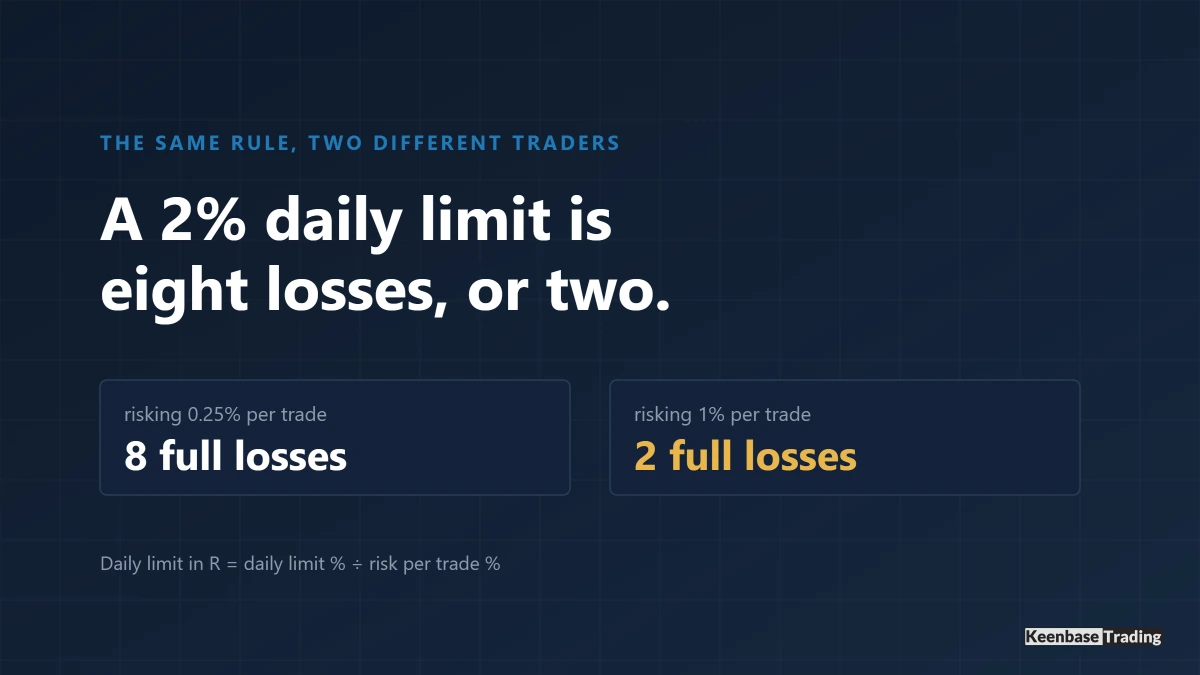
The trader risking a quarter of a percent would need eight straight full losses to be stopped. On three or four trades a day the rule can never fire, and it has been doing nothing for however long they have run it.
The trader risking a full percent is stopped by two. Assume a 45% strike rate and treat consecutive trades as independent, and the first two trades of the day are both losers about 30% of the time. Roughly one day in three would end after two trades, most of them ordinary days.
That figure is arithmetic rather than a study, so read it as an illustration of the mechanism, not a measurement of your system.
The useful reformulation: decide how many complete losses make a day abnormal for your method, and put the limit there. The percentage is an output of that decision rather than an input to it.
A limit set below your system’s ordinary loss string is not protecting you, it is editing your strategy. A method built on a low strike rate and a long payoff produces runs of losses by design, and a three-loss cap will remove the sequence while keeping the losses.
The winner that pays for such a run is the trade most likely to be cut off. At the other end, a daily limit you can hit repeatedly without troubling the account’s maximum loss is not doing much either.
Per-trade risk, the daily budget and the account’s maximum loss are three layers of one design, and they are worth setting together rather than one at a time. To see what a given level costs to climb back from, the Keenbase drawdown recovery calculator turns a drawdown into the gain required to undo it.
Note that R only works cleanly where the risk on a trade is genuinely predefined. Grids, scaling entries, variable exits and large floating exposure break the unit, and those strategies have to be studied directly on the equity path instead.
How to Find Your Own Number
The level you want is where continuing stops paying. There are two ways to look for it and they answer different questions, so which one applies depends on what you trade.
If You Trade a System: Replay It, Do Not Clip It
The tempting test is to take a finished equity curve, cut the worst days down to a candidate limit, and see whether the result improves. It always does, and it proves nothing, because a daily stop changes which trades happen afterwards.
Replay the sequence chronologically instead. Group historical trades by the same day definition you intend to enforce live, and reconstruct how the account moved through each day rather than how each day finished.
If the limit you plan to run responds to floating loss, closed-trade results are not enough and you need an equity path that carries open exposure.
That reconstruction is the whole point of the exercise. A day that falls deep and recovers looks harmless in end-of-day statistics, and a live rule would have stopped it in the hole and kept it there.
Then pick a candidate level, replay again, and apply exactly what the live rule would have done at the moment it was reached, including closing open exposure if that is the action you would use. Compare the two versions on questions that decide something:
- How much smaller did the worst days actually get?
- How much of the account’s overall drawdown did that remove?
- How much profitable trading was cut off after the stop fired?
- How often did the rule interrupt an ordinary day?
- Did the losses shrink, or did they simply move into later sessions?
The best limit is not the one producing the smallest bad day, since a tight enough stop guarantees that and takes the strategy with it. It is the level that removes an acceptable amount of tail risk for a tolerable amount of expectancy.
That follows from how the stop rewrites the trade sequence rather than from a test anyone has run for you, so it needs checking on the system you actually trade.
If You Trade Discretionarily: Measure the Trader
A backtest cannot contain the variable that matters here, because the person is part of the system. Rather than deciding you feel worse after losing, record it.
For every trade, note the day’s cumulative result in R at the moment you opened it. Then note whether the setup met your written rules, whether the size was the size you meant to use, whether the stop was where the plan put it, and what the trade returned.
Bucket the trades by that opening state: taken while the day was flat or up, down 1R, down 2R, down 3R. If the buckets look the same, you do not have a behavioural problem and a tight daily stop will only cost you trades.
If rule violations rise or expectancy falls off past a particular level and does not come back, you have found your limit, and you have a reason for it that a rule of thumb cannot give you.
Both methods share two honest limits. They describe the trader and the market you have already had, not the ones arriving next month. And they need a real sample: forty trades produce buckets of four, which is not an answer but the appearance of one.
Your Trading Day Probably Does Not Start When You Think It Does
Every timestamp in MetaTrader is broker server time. The daily candle opens and closes on the server’s clock, your account history is stamped with it, and the MQL5 TimeCurrent reference states that the value is formed on the trade server and does not depend on the time settings on your computer.
Your local midnight has no standing anywhere in the platform. Brokers do not agree on that clock, and some shift it seasonally, so the hour your trading day rolls over is a property of your account rather than of the market.
The Keenbase GMT offset calculator reads it off your Market Watch in a few seconds if you have never checked.
The trap is a rollover that lands inside your session. If your server day begins at 17:00 New York time, a trader who loses through the morning, steps away and comes back for the evening has crossed into a new trading day without leaving the desk.
Any automated daily limit has just reset. The rule exists for exactly that trader, and that is the moment the clock quietly stands aside.
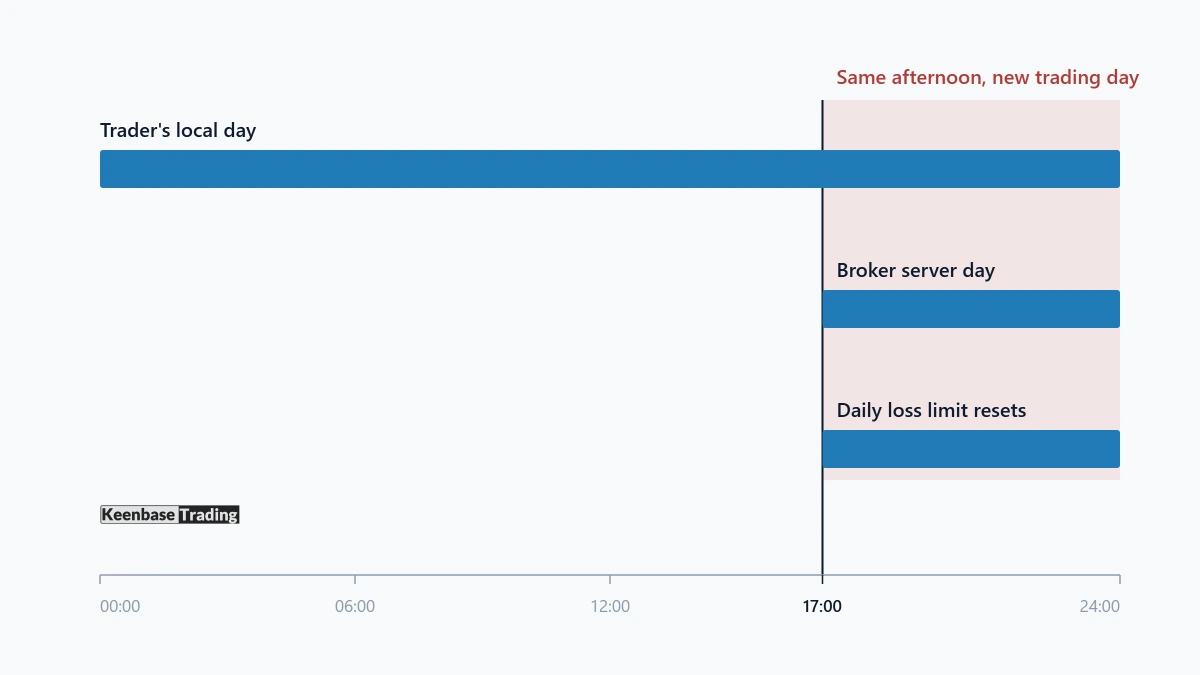
The boundary matters in the other direction too. If you hold positions across it, the reset does not close the position, reset the market or start a new trade. It changes the accounting period your rule measures against, which is worth watching before you rely on it.
It also decides whether the exercise in the previous section means anything. Group your history by calendar day while your broker runs on another clock and you will split real trading days in half and glue unrelated halves together, which is enough to blur the pattern you were looking for.
Reasons to Stop Before You Reach the Limit
The money is the outer boundary, not the only reason to end a session. Four situations make continuing pointless well before it.
- You have stopped running the process you tested: once you are overriding entries, moving stops, adjusting size or taking setups that do not meet the plan, the historical expectancy you are relying on belongs to a different method.
- A condition the method depends on has gone: if the edge lives in a particular session, volatility state or spread environment and that has changed, the remaining setups are not the setups you measured.
- Something is operationally wrong: duplicate orders, fills you cannot explain, gaps in the data feed, a symbol configured differently from the one you tested, or an EA behaving unlike its specification. These are incidents, not losing trades.
- Several strategies turn out to be one strategy: a portfolio that looks diversified by name can still hold a single exposure. When five EAs respond to the same move, the daily budget empties far faster than each of them would suggest alone.
Stopping Is a State, Not an Event
Deciding on a number is the easy half. The hard half is that stopping for the day describes a state you have to stay in, and closing your positions does not put you in it.
Flat is not stopped. Pending orders still sit on the server. Other EAs are still attached to their charts and still entitled to open something the moment their conditions are met.
The platform is still running, and placing one more trade takes about four seconds, which is roughly the amount of self-control the rule was supposed to remove from the situation.
The limit that matters is not the one you chose in the morning. It is the one still in force twenty minutes after you decided to stop.
Closing that gap is what KT Equity Protector EA is for. It runs on a single chart in MT4 or MT5, opens no trades of its own, and watches the whole account rather than the positions on its own chart, so one rule sits above your manual trades and your other EAs together.
For the daily loss rule you choose what the day is measured from, selecting between start-of-day balance, start-of-day equity, previous close balance and previous close equity. The limit itself is a percentage of that anchor or a fixed currency amount.
An optional safety buffer lets it act before your stated line rather than on it. That matters most when the line belongs to somebody else, such as a funded account rule you cannot afford to touch.
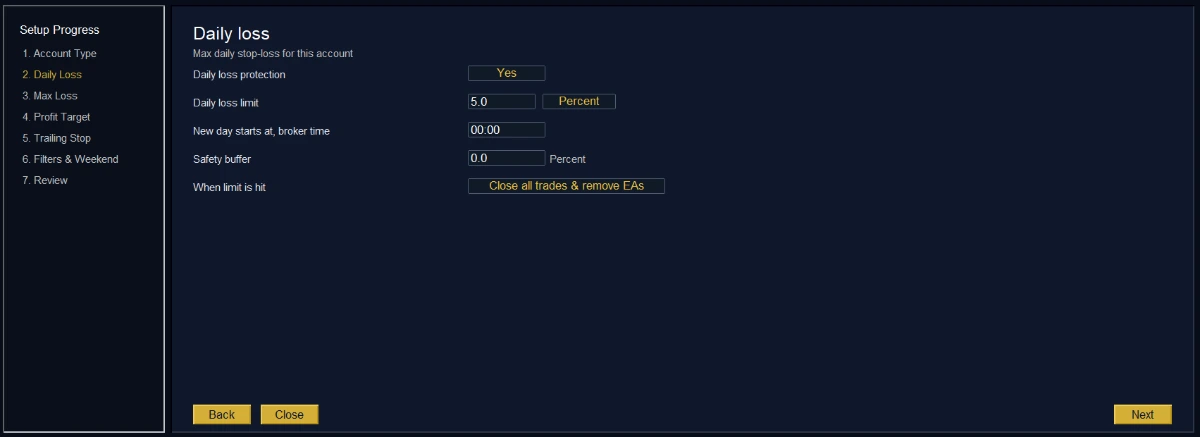
The reset is a configurable time in broker time, which makes the previous section operational: you set the hour your day actually turns over instead of inheriting a default. The Prop Firm profile locks that reset to 00:00 to match how firms grade the day.
It also keeps the day’s peak consumed percentage rather than letting a recovery erase the fact that the account had been close to the line. A rule that forgets how deep the day went is measuring the wrong thing.
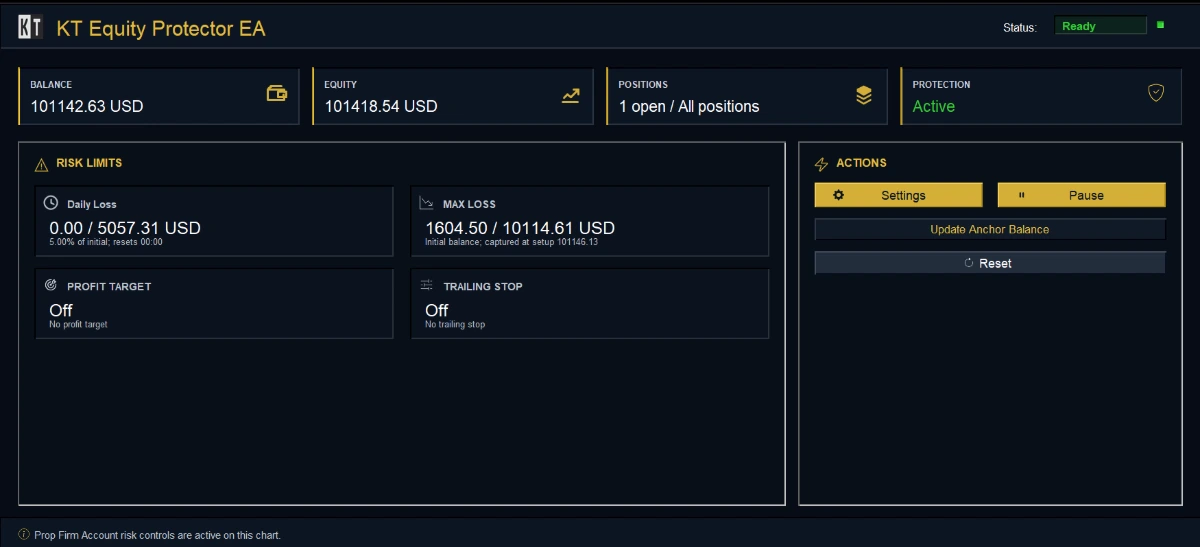
What makes it a stopping rule rather than a closing rule is what happens after it fires. You choose the action, from an alert through to closing every position and removing every other Expert Advisor from the terminal.
Pending orders are cancelled alongside positions, rejected close requests are retried, and the account then holds a reset-required state until you physically click Reset on the dashboard. Every trigger, close and retry is written to a daily CSV log.
One decision inside this is worth making deliberately. A rule watching equity includes floating loss, so a position that would have recovered can trip it before it ever closes, while a rule watching balance can sit silent through a drawdown that is plain on the screen.
Neither is wrong. Choosing by accident is. If you trade a funded account the choice is made for you by whichever figure the firm grades, and prop firm rules change often, so confirm the current version with your provider before configuring anything to match them.
Be clear about what none of this does. It cannot act while the terminal is closed or disconnected, which is the argument for a VPS rather than a laptop lid. It will not stop you clicking Reset and trading anyway, because software cannot.
What it removes is the specific failure where a rule you genuinely meant to follow was never actually in force at the moment it mattered.
The Two Numbers Worth Settling
Most traders who say they use a daily loss limit have settled the first number and never looked at the second.
The first is the level: how many full losses make the day abnormal for your system, taken from your own record rather than from a percentage someone published.
The second is the mechanism: what will actually be in force at the moment you would otherwise take the trade you have already decided not to take.
If the honest answer to the second is your own judgement, then the rule and the thing it protects you from are the same faculty, which is the arrangement the rule exists to avoid.
KT Equity Protector EA gives you the second number: one chart, one configured daily rule, and an account that stays stopped until you decide otherwise.
Set your daily loss limit once and let it hold
About this article
Published by Keenbase Trading. We have been trading since 2018 and build MetaTrader 4 and MetaTrader 5 indicators, Expert Advisors, free tools and custom development for traders.
Prop firm rules and broker server times change often, so check the current limits with your firm and the current offset with your broker before relying on them.