
Master Forex Funded Accounts with Smart Risk Management
Mastering a funded account is two separate problems, and almost every guide only covers the first.
The first is passing the evaluation. The second is holding the account long enough to be paid, and the largest public dataset says that is where most of the survivors are lost.
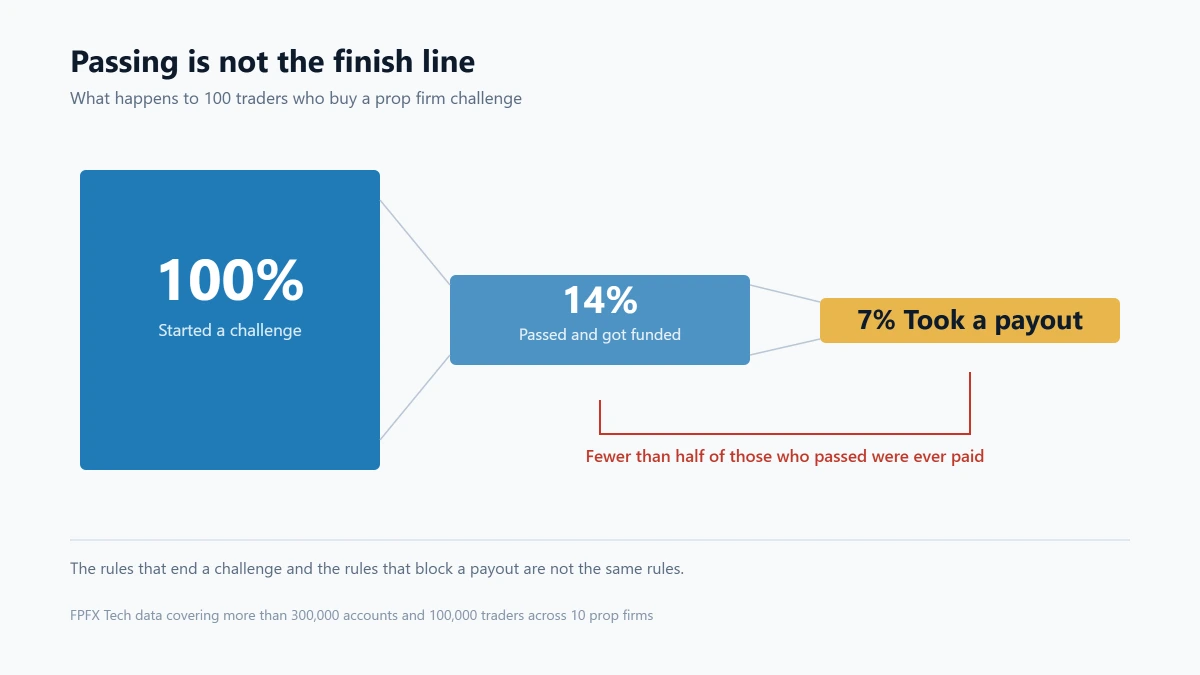
FPFX Tech, which supplies technology to prop firms, gave Finance Magnates data covering more than 300,000 accounts across 100,000 traders at ten firms. 14% of traders passed a challenge. Of those, about 45% ever took a payout.
That is 7% of everyone who started, and it means more than half the people who did the hard part still walked away with nothing.
The reason is structural: the rules that end a challenge and the rules that block a payout are not the same rules. Preparing only for the first is why the funnel looks like that.
The challenge is arithmetic before it is discipline
The standard advice is to risk 1% to 2% per trade. That is a number without a denominator, and it does not tell you the thing you need to know.
The useful number is how many losing trades sit between you and a breach. It is fixed the moment you choose a position size, and you can work it out in one line.
Take FTMO’s 2-Step Challenge on a $100,000 account. Its published trading objectives are a 10% profit target in phase one, a 5% maximum daily loss, and a 10% maximum loss that is static, so the floor stays at $90,000 whatever happens.
At 2% risk per trade you are five losing trades from that floor. At 1% you are ten. Nothing about your strategy changed between those two sentences. Only the number of consecutive mistakes you can survive did.
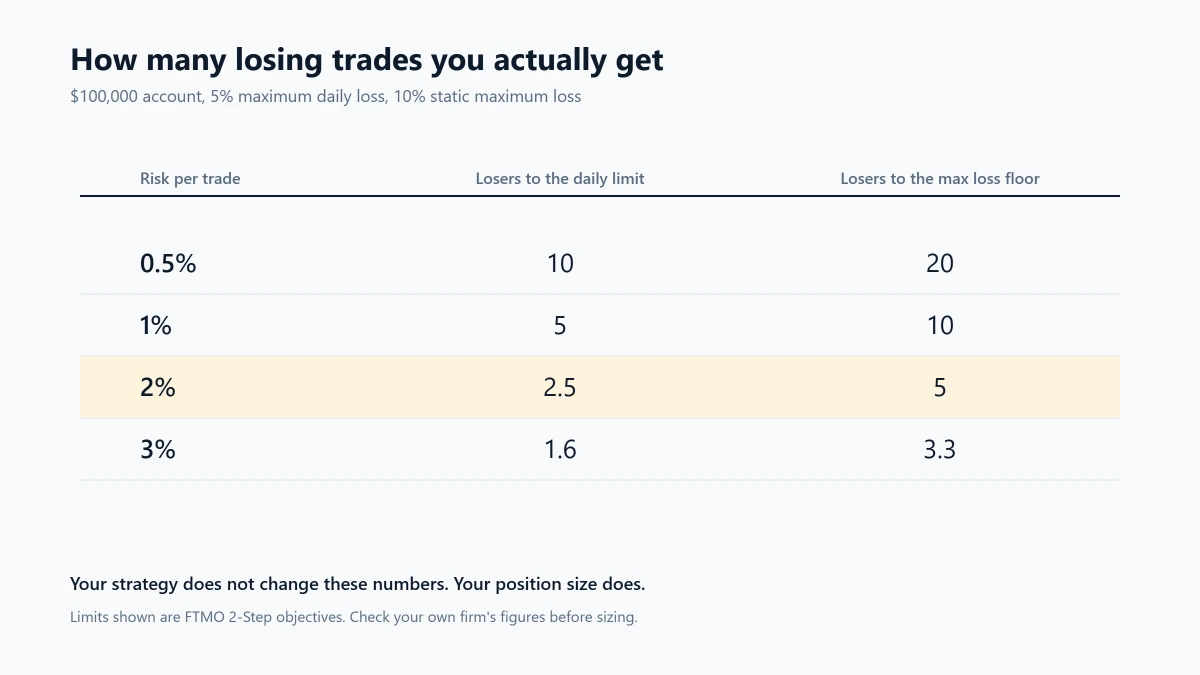
The daily limit binds sooner than most people expect. A 5% daily loss on the same account is two and a half trades at 2% risk. Three losers before lunch and the day is over.
What you can actually lose right now is a smaller number
The account size is not your risk capacity. What matters is the distance between current equity and the nearest rule that can end the account, minus whatever you hold back for execution.
usable budget = breach distance − your safety buffer
Say equity is $98,600, the active daily floor is $95,000 and you hold back $500. Your breach distance is $3,600 but your usable budget is $3,100.
Now suppose three correlated positions are already open, each able to lose another $800 before its stop executes. That cluster carries $2,400 of committed downside, so the room actually available for a new trade is $700, not $3,100.
This is arithmetic rather than a tested rule. The right buffer and exposure limits still have to come from your own instruments and execution history.
Midnight can change your risk while you do nothing
Daily resets deserve more attention than they get, because the reference value moves while your position stays exactly where it is.
FTMO recalculates the daily limit at 00:00 CE(S)T from that moment’s account balance, minus a maximum daily loss amount of 5% of initial capital. Follow what that does across one midnight.
A $100,000 account opens the day with a $95,000 daily floor. During the day you realise $2,000, lifting the balance to $102,000. Later an open position develops a $3,000 floating loss, so equity sits at $99,000.
Before midnight the original $95,000 floor still applies, so you have $4,000 of room.
At the reset the balance reference becomes $102,000. Subtract the $5,000 daily loss amount and the new floor is $97,000.
Nothing about your position changed: equity is still $99,000. Your room has fallen from $4,000 to $2,000 purely because the reference reset underneath you.
Anyone holding through a rollover who checks only their floating profit and loss is working from the wrong number. This follows directly from FTMO’s published calculation rather than from any test.
Some firms now write position size into the rulebook
The folk rule about 1% to 2% is being overtaken. Several firms have stopped suggesting a size and started defining one, with more precision than most traders apply to themselves.
FundingPips Zero publishes a maximum open risk limit of 1% of the starting account size, measured in real time against combined floating loss across every open position. Losing positions count, and a profitable trade cannot offset a losing one.
It also caps the loss on a single trade idea at 3% below a $50,000 account and 2% at $50,000 and above, and it defines a trade idea to include any position reopened in the same direction within ten minutes of closing a losing one.
That last clause matters more than it looks. It closes the gap between risking 2% per trade and losing 6% on the same idea in twenty minutes, which is how a lot of accounts actually die.
Read the definition before you size anything: two firms quoting the same percentage can be measuring different quantities, and the one that groups re-entries is stricter than its number suggests.
The rules that stop you after you pass
This is the part of the funnel the guides skip, and it is where the other half of the funded traders are lost.
Once funded, the daily and maximum loss rules still apply, but a second category appears: rules about the shape of your equity curve rather than its level.
- FTMO’s Best Day rule: your single best day must be no more than 50% of your total profit from all positive days. Exceeding it is not a breach, but you must keep trading until the ratio comes back.
- FundingPips applies a consistency score: your biggest winning day must not exceed 15% of accumulated profit, and reward requests are blocked until it does not.
- FundingPips Zero adds more: at least seven profitable days of 0.25% or more in each rolling 30-day period, the first 3% of profit ineligible for reward, and your largest losing trade must not exceed your largest winning trade.
None of these can be satisfied by a single good trade. Several are made worse by one.
That is the uncomfortable inversion. The outsized winner that carried you through phase one is exactly the trade that can lock your payout behind weeks of further trading.
What it changes in practice: if you intend to be paid rather than merely funded, you need a distribution of results, not a result. Plan the number of trading days before you plan the profit.
Your firm’s breach line is not a place to start closing
A prop firm’s limit is a termination threshold. It is a terrible level at which to begin flattening several positions.
Closing exactly there leaves nothing for spread widening, slippage, commissions, price movement during the close sequence, or a rejected close request. Your own action level has to sit before it.
Acting at 4.8% when the firm’s line is 5% is an example, not a recommendation. The right gap reflects how long detection to flat actually takes on your account, and one position in normal liquidity is not the same problem as ten correlated ones in a news spike.
Where automation fits
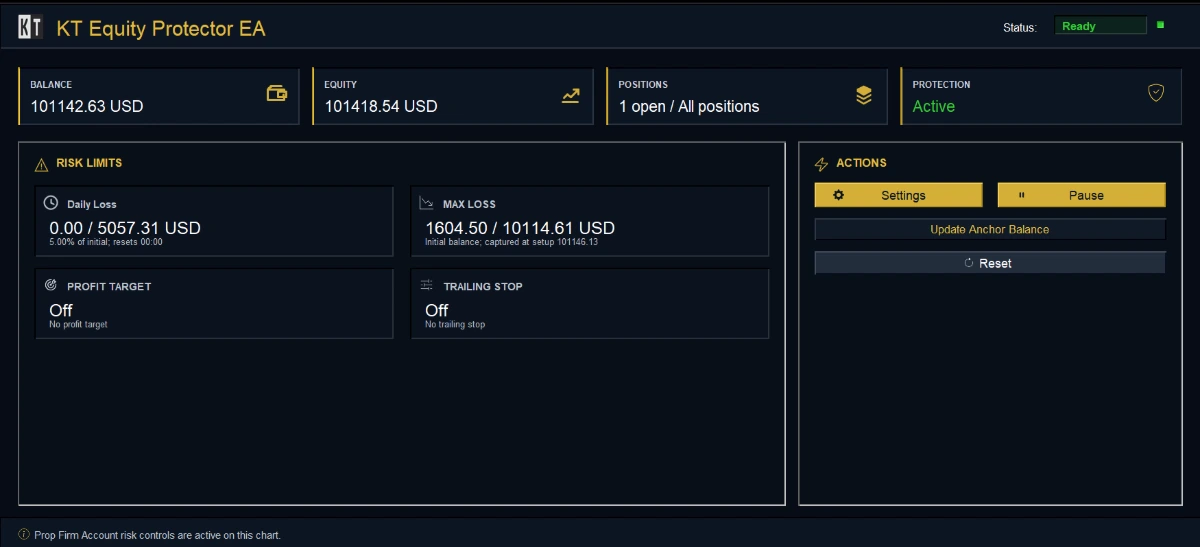
KT Equity Protector EA exists to enforce these boundaries inside MetaTrader. It does not trade or choose direction. It attaches to one chart, watches the whole account, and acts when a line you set is crossed.
Setup opens by asking whether this is a Personal Account or a Prop Firm Account, and the remaining questions, dashboard and defaults reshape around that answer.
The part that matters for a funded account is that the calculation model can be made to resemble your firm’s actual rule rather than just its percentage.
The daily rule needs the right anchor
The daily loss limit can anchor to start-of-day balance, start-of-day equity, previous close balance or previous close equity, as a percentage or a fixed amount, with an optional safety buffer.
This matters because “5% daily drawdown” is not a complete specification. You still need to know what the firm measures it from, which is the whole point of the midnight example above.
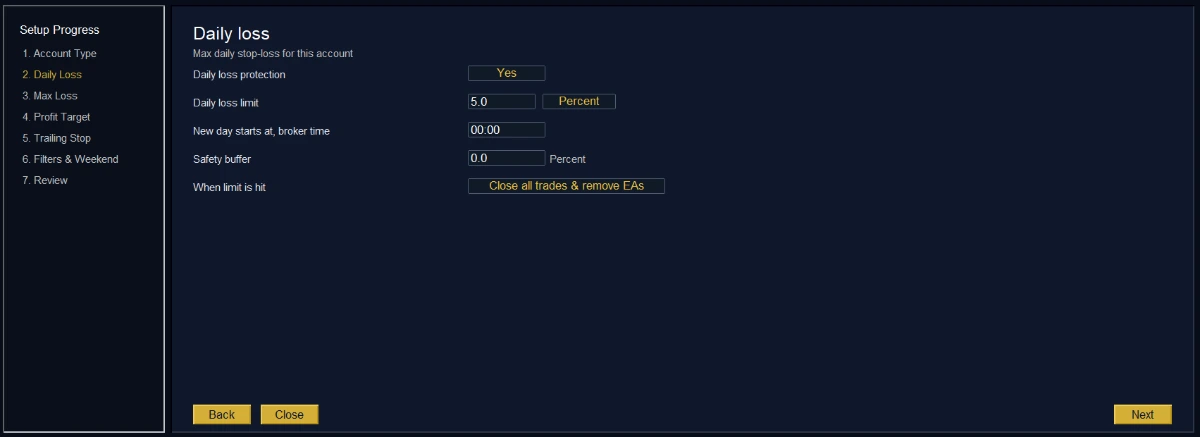
In the Prop Firm profile the reset is locked to 00:00 broker time, so confirm that your broker’s midnight is the same midnight your firm grades on. They are frequently not.
Max loss and the trailing stop answer different questions
The max loss rule anchors to the initial balance, a custom starting balance, or a trailing peak of balance or equity, so it can be matched to a static or a trailing firm rule.
The equity trailing stop is a separate rule. It arms only after a profit threshold you set, then fires if equity gives back more than you allow from its peak. One protects the firm’s hard floor; the other protects profit you have already made.
Keeping them separate is what lets you survive a bad week and still bank a good one, and it is why they are configured independently rather than as one setting.
One breach event should also stop the next trade
Closing positions is half the problem when another EA can reopen one seconds later. The action list runs from alert only through closing losers or winners to closing everything and removing every other Expert Advisor from the terminal.
Pending orders are cancelled, rejected closes are retried, and afterwards the account holds a reset-required state until you click Reset. A recovery in equity does not quietly clear an event that already happened.
Every trigger and attempt is written to a dated CSV with balance, equity, floating profit and loss and position count, which is what lets you reconstruct afterwards whether the trigger came from a realised loss, a floating loss or the reset.
Two limits worth stating plainly: it cannot act while MetaTrader is closed, which is the argument for a VPS on any funded account, and it cannot make your equity curve the right shape.
A consistency rule or a best-day rule is a question about how you trade across weeks. Software enforces a threshold. The distribution is yours.
Test the rule engine, not the strategy
An EA that opens no trades has no profit factor to optimise, so the Strategy Tester will load it and tell you nothing useful. The question is whether your configured rule behaves as expected, and that needs a demo account.
- Reproduce the funded account’s starting balance and rules as closely as you can, then configure both anchors and your buffer.
- Create controlled floating and realised losses, and watch the behaviour on both sides of the daily reset.
- Trigger each protective action deliberately, including the one that removes other EAs.
- Restart MetaTrader with the state armed and confirm the anchors and peaks come back.
- Read the CSV afterwards and check it matches what you watched happen.
If you run several strategies or correlated symbols, repeat it with multiple positions open. The goal is not to prove the EA makes money. It is to know exactly what it will do before a funded account depends on it.
The five numbers to write down before you start
Not advice. Arithmetic. Do this before the first trade, in the currency of the account.
- Losing trades to the maximum loss floor, at your intended position size.
- Losing trades to the daily limit, at the same size.
- What the daily limit is anchored to, at what time, in which timezone it resets.
- What the consistency or best-day rule requires, expressed as the largest single day you are allowed given your target.
- What happens to the floor after a payout: reset, hold, or move to the post-withdrawal balance.
If you cannot fill in all five from the firm’s own rulebook, you do not yet know what you have bought.
Passing gets you an account. Only the second list gets you paid.
Enforce your firm’s limits with KT Equity Protector EA
About this article
Published by Keenbase Trading. We have been trading since 2018 and we build MetaTrader 4 and MetaTrader 5 indicators, Expert Advisors, free tools and custom development, including the account protection EA discussed above.
Prop firm rules change often. Every figure here was read from the firm’s own rulebook, but check the current limits, anchors and reset times with your firm before relying on them.