
Balance Based vs Equity Based Drawdown: What Actually Counts Against Your Limit
Balance based drawdown measures declines in account balance, so the profit or loss of open positions is excluded until you close them. Equity based drawdown measures declines in account equity, which is balance plus floating profit and loss, plus swaps and commissions.
So the question traders keep asking, does unrealized loss count toward drawdown, has a direct answer: under a balance measurement it does not, and under an equity measurement it does, from the first tick it appears.
The complication, and the reason accounts fail rules their owners thought they understood, is that almost no real drawdown rule is purely one or the other. A rule can take its reference level from balance and still judge you on equity.
That combination is not a fringe case. It is the standard configuration at most evaluation firms, and it means the phrase “balance based” usually describes only the anchor, not the test that fails your account.
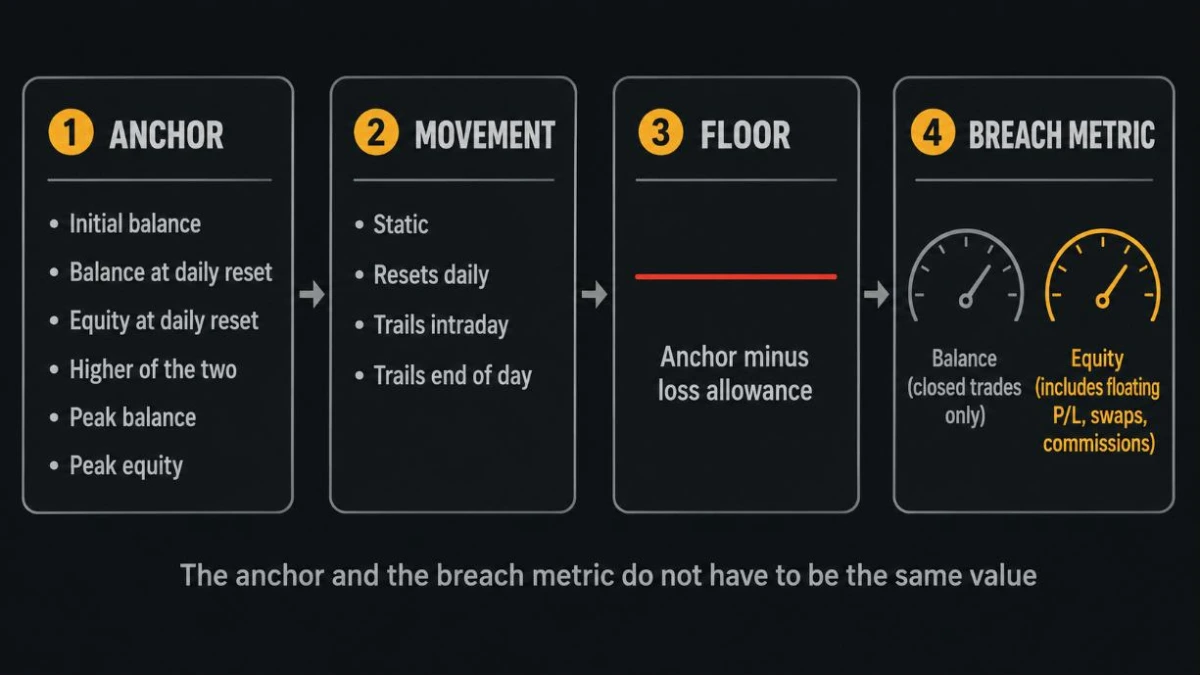
A drawdown rule has three moving parts, not one
Before you can answer whether floating loss counts, you have to separate three things that get compressed into a single label:
- The anchor: the value the loss allowance is subtracted from. It can be the initial deposit, the balance at the daily reset, the equity at the daily reset, the higher of the two, a custom starting balance, or a running peak.
- The movement: whether that anchor is static, resets daily, trails a new high, or updates only at end of day.
- The breach metric: the live account value that must stay above the resulting floor. This is where balance or equity actually decides your fate.
FTMO’s published trading objectives show all three axes moving independently within a single firm. On the 2-Step programme, the Maximum Daily Loss Limit is recalculated at 00:00 CE(S)T as the account balance recorded at that moment minus 5% of the initial simulated capital.
The value that must not fall below that limit is account equity, defined as balance plus open position P/L plus or minus swaps and minus commissions.
The 2-Step Maximum Loss is static, calculated once from the initial simulated capital minus 10%, and also graded on equity.
On the 1-Step programme the Maximum Loss instead trails end of day, recalculated daily from the highest balance recorded at 00:00 CE(S)T on any preceding day, and it can only increase.
Same firm, three different anchor and movement combinations, and equity as the breach metric in every one of them.
Other firms move the anchor in the opposite direction. FundingPips calculates its daily loss allowance from the higher of the opening balance or the opening equity for the day, then requires equity to stay above the resulting floor.
That single word, higher, changes the behaviour of the rule completely, as the next section shows.
The practical takeaway is not a list of which firms are supposedly balance based. Programmes change, and two products from the same firm can use different models. Read the rule and identify the three components separately.
The same trade, scored two ways
Take a 100,000 account with a 5% daily allowance, so 5,000 of room and a floor at 95,000.
You open a position. It runs 5,400 against you before turning, and you eventually close it for a realized loss of 900.
Balance measurement: nothing happened until the close. Balance moves from 100,000 to 99,100. You used 900 of your 5,000. The 5,400 excursion never existed as far as the rule is concerned.
Equity measurement: the moment equity printed 94,600 you were below the floor. The account is breached. The recovery, the good exit and the small realized loss are all irrelevant, because the rule was evaluated on a tick you were probably not watching.
That is the entire practical difference, and it is why the two models reward opposite behaviour. A balance measurement pays you for holding a loser through the excursion. An equity measurement charges you for it at the worst point it reached.
Under an equity rule, your position sizing has to be built around maximum adverse excursion, not around the outcome of the trade.
The overnight carry trap
The anchor and the breach metric interact in a way that quietly changes your allowance before you place a single trade, and it works in both directions depending on which anchor your firm uses.
With a balance anchor, as in FTMO’s daily loss rule, suppose it is one minute before 00:00 and you are holding a position 800 in the red, unrealized. The new limit is calculated from balance, which does not know about that 800. One second after the reset, your equity is already 800 below the anchor.
You have not traded today, and you have already consumed 800 of a 5,000 allowance. Your real room for the session is 4,200.
With a “higher of balance or equity” anchor, as FundingPips uses, the trap reverses. Suppose at the reset your balance is 105,000 and an open position carries 2,000 of floating profit, so equity is 107,000. The higher value becomes the baseline. On a 3% allowance the floor is 107,000 minus 3,210, or 103,790.
If that floating profit simply evaporates and equity returns to 105,000, you have lost nothing relative to your balance, yet only 1,210 now separates you from the daily floor. Holding an unrealized winner through the reset raised the bar you have to clear.
The usable number is never the headline percentage. It is:
Usable allowance = (anchor x limit %) – current floating P/L
Floating P/L is negative when you are down, so a carried loss subtracts twice: once as the loss itself, and once from your assumption about how much room you had.
Anyone who holds positions through a daily reset should compute this figure before the first trade of the session rather than after the breach email arrives.
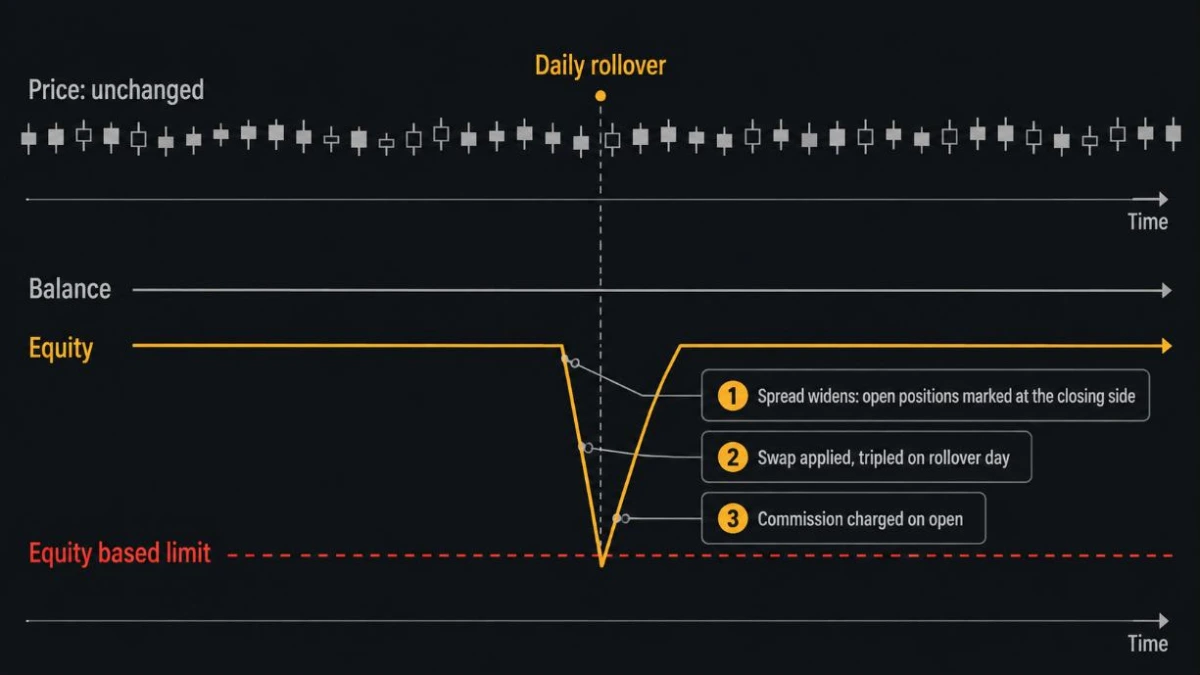
Equity can fall while price does nothing
Under a balance measurement, equity movement is noise. Under an equity measurement it is the scoreboard, and the scoreboard moves for reasons that have nothing to do with direction.
- Spread widening: an open buy is valued at the current Bid and an open sell at the current Ask, because those are the prices that would close them. When liquidity thins at rollover or on a news release, the spread widens and one side of your book is marked deeper into the red with no directional movement at all.
- Swap: financing is applied at rollover and appears in floating P/L before it is ever realized. On the triple swap day it lands at three times the size. A carry heavy book can drift toward a breach overnight with the trader asleep and the chart flat.
- Commission: where the broker charges on open, the cost hits equity from the first tick of the position’s life.
A basket of positions held across 23:59 server time can shed a real slice of equity to spread alone and hand it straight back a minute later.
None of these are catastrophic on their own. They matter because equity rules are graded on the lowest point equity reached, not on where it settled, so these costs are scored at their maximum rather than their average. Balance never sees any of them until the position closes.
Your existing backtest already shows which model would have failed you
This is the cheapest diagnostic available and most traders never run it.
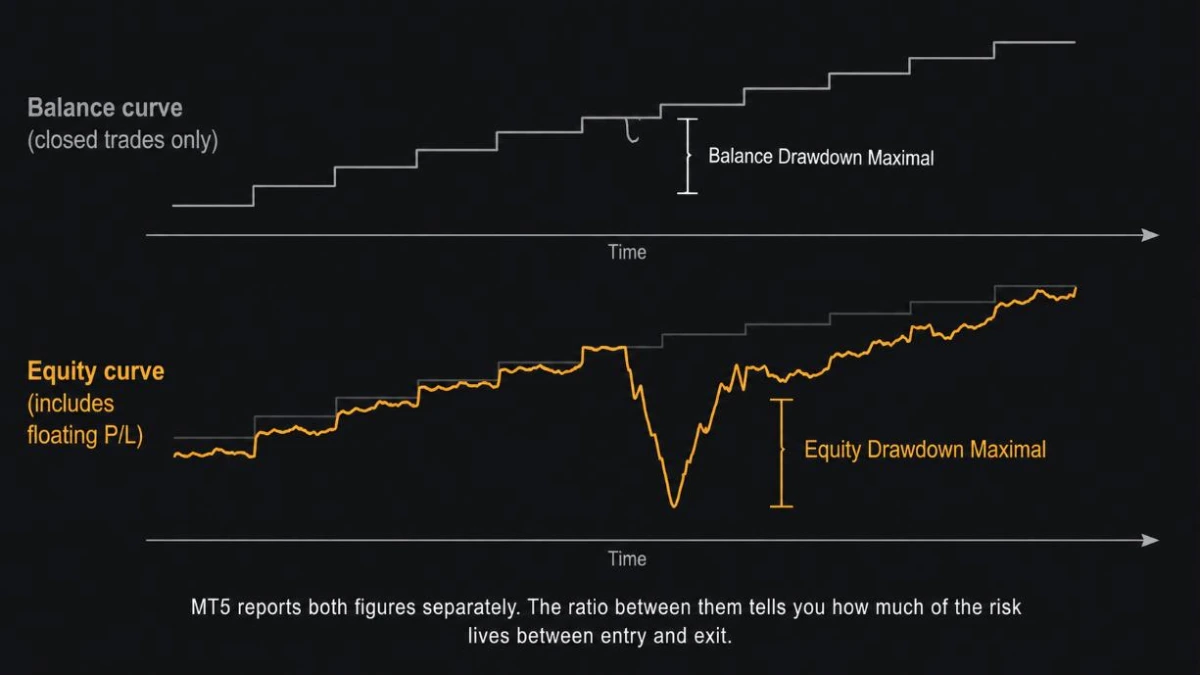
The MT5 Strategy Tester reports the two measurements separately. MetaQuotes defines them in the MetaTrader 5 testing report documentation as Balance Drawdown Maximal, the largest difference between a local balance high and the next balance low, and Equity Drawdown Maximal, the same calculation applied to the equity curve.
Programmatically they are exposed as STAT_BALANCE_DD and STAT_EQUITY_DD through TesterStatistics().
Two details in that report are worth knowing before you trust it. The MQL5 reference defines STAT_RECOVERY_FACTOR as net profit divided by balance drawdown, so a strategy whose equity curve repeatedly went near death can still publish an attractive recovery factor.
The tester also evaluates equity only at modelled ticks, so under “Open prices only” or M1 OHLC modelling the worst intra-bar excursion is never sampled and the equity drawdown figure is understated, sometimes badly.
If the number is going to inform a decision about an equity based rule, run it on real ticks in MT5 or every tick in MT4 and treat anything from a faster modelling mode as a floor rather than an estimate.
MT4’s report is arranged differently and is easy to misread. Absolute drawdown is the largest dip below the initial deposit, while Maximal drawdown and Relative drawdown are both defined against the highest local equity value and the following lowest equity value.
The single headline number is equity based even though the tester graph most traders look at is drawn from balance, which is exactly why a grid or averaging EA can present a clean staircase graph beside a drawdown figure that does not appear to match it.
The test itself takes five minutes:
- Run the strategy over the period and settings you intend to trade, using the highest available tick modelling.
- Record Equity Drawdown Maximal and Balance Drawdown Maximal.
- Divide equity drawdown by balance drawdown.
A ratio close to 1 means the strategy realizes losses at roughly the point it incurs them, and both rule models will grade it similarly. A ratio of three or five means the strategy survives on unrealized pain. It will pass a balance measurement and fail an equity measurement on exactly the same trades.
For per position detail, the MT5 report includes an MAE-Profits distribution chart, which plots each position’s maximum adverse excursion, the deepest unrealized loss it reached during its lifetime, against its final result.
That chart answers the question an equity based rule actually asks, which is not how much you lost but how far underwater you went, and it identifies the individual trades that would have tripped a limit.
MetaTrader does not enforce any of this for you
There is no native account level equity stop in MT4 or MT5. The only built in equity mechanism is the broker’s margin call and stop out, which sits far below any evaluation limit and far below the point at which most traders would want to be flat.
Stop losses on individual positions do not close the gap either, because an account level rule is breached by the sum of open positions plus realized results, and no single position’s stop knows anything about the others.
What is left is continuous monitoring, and continuous means every tick, including the ones during a news spike, at rollover, and while you are asleep. That is not work a human does reliably, and under an equity measurement it is the only work that matters.
This is the specific gap KT Equity Protector EA is built to fill. It does not open trades or alter entry logic.
It runs on a single chart, monitors the whole account alongside your manual trades and other EAs, and executes the action you configured when a line you defined is crossed.
What makes it relevant to this particular topic is that its anchor options map onto the three part structure above rather than imposing one interpretation of drawdown:
- Daily loss anchors: start of day balance, start of day equity, previous close balance, or previous close equity, with the limit expressed as a percentage or a fixed currency amount and a configurable reset time in broker time.
- Max loss anchors: initial balance, trailing highest balance, trailing highest equity, or a custom starting balance, with the anchor re-settable from the dashboard.
- Breach metric: account equity, monitored continuously, which is the whole point. The EA fires on the same quantity the firm grades you on.
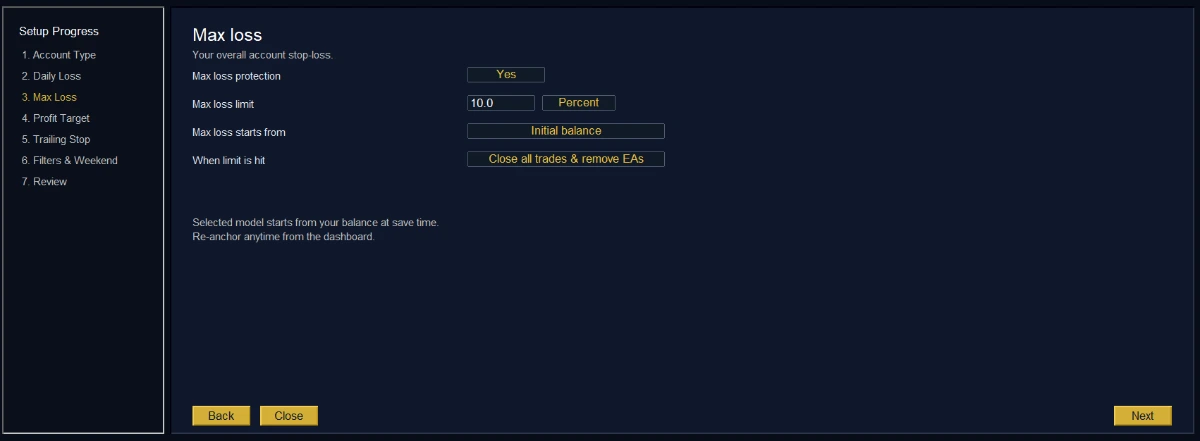
Two implementation details matter more than the feature list. The first is the safety buffer, which lets you trip the rule before your stated limit, for example acting at 4.8% when the firm’s line is 5%, so that slippage on the closing fills does not turn a near miss into a breach.
The second is that the strongest configured action closes every position in scope and removes every other Expert Advisor from the terminal. Under an equity rule that is not overkill, because closing positions achieves nothing if another EA reopens them ninety seconds later while the consumed percentage for the day is still sticky.
It also writes a timestamped CSV log recording balance, equity, floating P/L and position count at every event, which is a realistic way to answer the question raised in the previous section about how far your equity actually fell on a live account, where MetaTrader archives nothing of the kind by default.
Matching your configuration to the rulebook
Read your firm’s rules for three things, the reset time, the anchor, and the value that triggers the breach. Then configure to match.
- “Daily limit calculated from the balance at 00:00, equity must not fall below it”: start of day balance anchor, equity measurement, buffer set inside the stated limit. This is the FTMO style rule and the one where the overnight carry trap applies.
- “Daily limit calculated from the higher of opening balance or opening equity”: start of day equity anchor when you are carrying an unrealized profit through the reset, because that is the value the firm will use.
- “Maximum loss is static from the initial account size”: initial balance anchor, no trailing.
- “Maximum loss trails the highest end of day balance”: trailing highest balance anchor. Intraday spikes do not move the floor, which is materially more forgiving than it sounds.
- “Maximum loss trails your highest equity”: trailing highest equity anchor. This is the strictest common configuration, because an unrealized spike raises the floor permanently even if you never bank it.
- “Drawdown measured from a specified starting figure”: custom starting balance, which is what you need after a payout, a reset, or when a funded account starts at a different number from the challenge.
One mismatch causes more accidental breaches than any of the above: time zones. Firms usually state the reset in CE(S)T or New York time, while your terminal runs on broker server time, commonly GMT+2 or GMT+3 depending on the season.
Configure your reset an hour or two away from the firm’s and you create a daily window in which two different anchors are live at once, so losses booked in that window are charged to the wrong day.
Confirm the offset before configuring anything, using your terminal’s server time or the free GMT offset calculator, and re-check after every daylight saving change.
Which model is better is the wrong question
Balance measurements are easier to survive, and that is precisely the problem with them. They stay silent while a position runs against you, so they reward holding losers, which is the behaviour that empties accounts on the occasion the excursion does not recover.
Equity measurements are harsher and will stop you out of trades that would have come back, but they force position sizing that respects the worst point of a trade rather than its last point.
Choosing a firm because its drawdown model looks looser is a bet that your strategy’s worst excursion stays inside a limit you have never measured. Measure it first, from the tester or from your own account history, and then decide.
Whichever model you end up trading under, the enforcement problem is identical. The firm checks continuously, so something on your side has to check continuously too, which means a rule running inside the terminal rather than a number written on a sticky note.
KT Equity Protector EA is one way to close that gap. It gives you the anchor models to mirror your firm’s rule, an equity based trigger that fires at a buffer inside your stated limit, and a timestamped CSV record of every event, on MT4 and MT5.
Map its anchors to the exact rules of the account you are protecting and the limit stops depending on you being at the screen.
See how KT Equity Protector EA enforces your limits
About this article
Published by Keenbase Trading, which has built MetaTrader 4 and MetaTrader 5 indicators, Expert Advisors and free trading tools since 2018. The platform behaviour described here comes from building and supporting those tools.
Prop firm programmes change, and two products from the same firm can use different drawdown models. Nothing above is a list of which firm uses which. Use it to read your own rulebook, and confirm the model your account is actually graded on before you rely on it.