
Can You Actually Automate Smart Money Concepts? An Honest Look at SMC and ICT EAs
Traders ask us to build SMC and ICT robots more than almost anything else. They have spent months marking order blocks and fair value gaps by hand; the setups work, and the obvious next step is to hand the whole thing to an EA and let it run. Then they hit a wall nobody warned them about.
Smart Money Concepts can be automated. Parts of it automate cleanly. But the parts traders care about most are the parts that fight back hardest, and knowing which is which saves you a lot of money and a lot of disappointment.
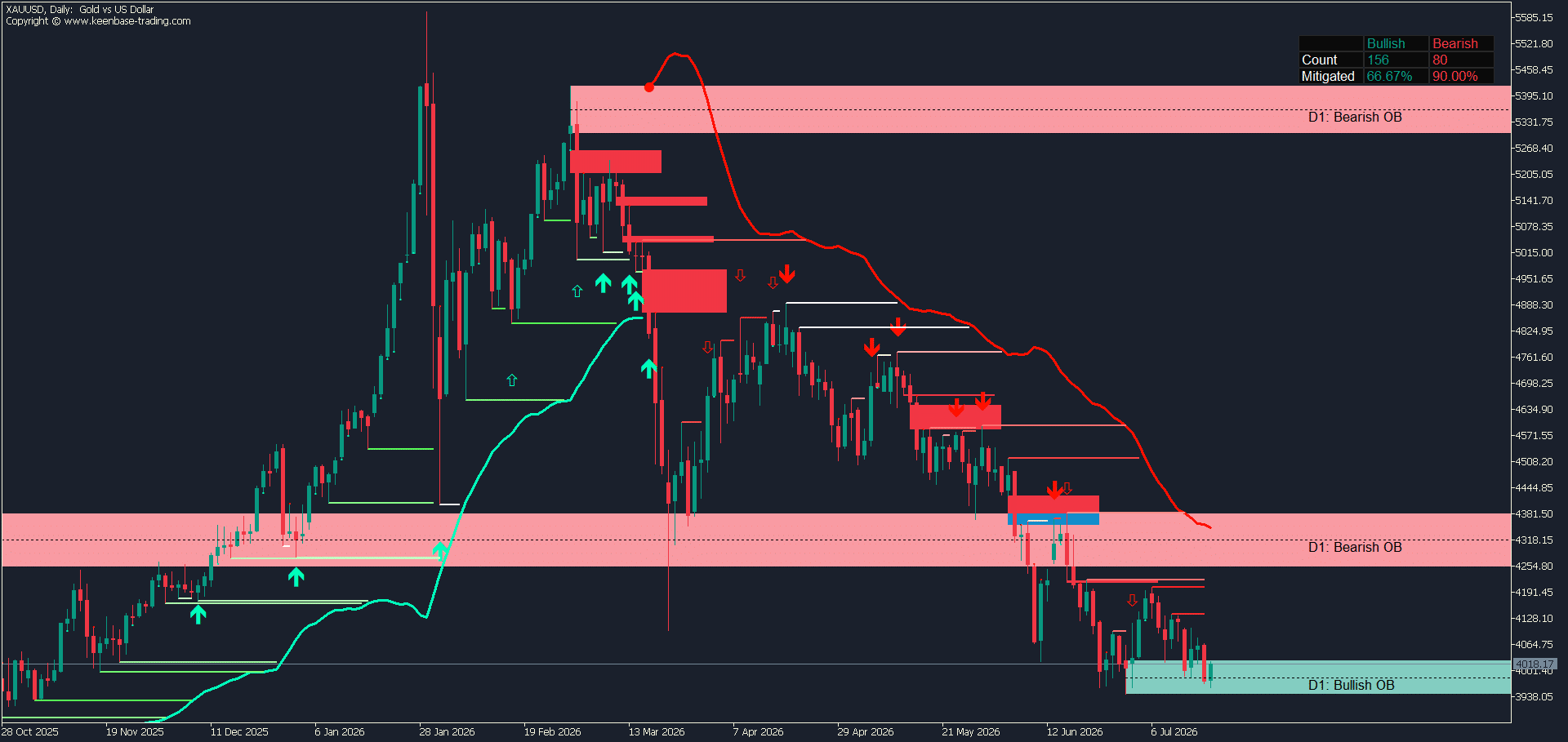
What SMC and ICT actually ask a computer to do
Strip away the vocabulary, and an SMC strategy is a sequence of pattern recognitions stacked on top of each other. Price runs a swing high, then grabs the buy stops resting above it. Structure breaks to the downside. A fair value gap forms on the drop. Price retraces into an order block sitting inside that gap, during a specific session window, and only then do you enter.
Every one of those steps must be defined in code before an EA can trade. Some of them are defined beautifully. Others depend on your eye in a way that is genuinely hard to pin down, and pretending otherwise is how people end up with an EA that trades nothing as they do.
The parts that automate cleanly
Fair value gaps are the easy win. An FVG is a three-candle imbalance with a precise definition: the high of the first candle sits below the low of the third, leaving an untouched gap in between. That is arithmetic. A computer spots it faster and more consistently than you ever will, tracks whether the price has filled it, and never misses one because it looked away.
Liquidity sweeps code well, too, as long as you accept a working definition. A bullish sweep is a price dip below a prior equal low and closing back above it. A bearish sweep is the mirror. Once you commit to the exact rule, the EA applies it without the second-guessing that a human does.
Break of structure and change of character are codeable once you fix how a swing point is defined. Give the EA a lookback rule for what counts as a swing high or low, and it can flag a BOS when price closes beyond the most recent one, or a CHoCH when the first opposing break appears. Consistent, tireless, no missed levels.
Session and kill zone timing is trivial for a machine and a real edge. London and New York windows, the exact hours you want the EA awake and the hours you want it flat, are enforced to the minute. No human discipline required.
The parts that fight back
Order blocks are where it gets hard, and order blocks are usually the heart of the strategy. Ask ten SMC traders to mark the order block on the same chart, and you will get several different boxes. Is it the last down candle before the move, or the whole cluster? Does an inefficiency have to sit next to it? Does it only count with a liquidity sweep first?
Your eye resolves this in a second using context you are not consciously aware of. Code cannot use judgment it was never given, so every one of those instincts has to become an explicit rule, and the rules are where two SMC traders quietly disagree.
Market structure in messy conditions is the second hardest problem. Automated structure detection works well in a clean trend and mislabels constantly when the price goes choppy.
A run of overlapping candles produces a mess of tiny highs and lows, and a naive EA reads false break after false break, firing entries a human would dismiss with one glance. Taming this takes real work: minimum displacement thresholds, higher timeframe filters, and inducement logic to tell a genuine break from a stop-loss raid.
Higher timeframe bias, the thing that makes SMC work, is the hardest to transfer. A good discretionary trader carries a top-down read in their head. Daily bias is bullish, so on the 15-minute, I only take longs from discount order blocks after a sweep of sell-side liquidity.
Automating that means the EA has to hold and update a multi-timeframe model of the market and weigh confluence across it, not just pattern match on one chart. This is the difference between a toy that draws boxes and a system that trades your actual edge.
Why so many SMC EAs disappoint
Most of the SMC robots people buy off the shelf fail for the same reason. They automate the easy 80 percent, the FVGs and the sweeps and the pretty boxes, and quietly skip the hard 20 percent that carried your results.
The strategy that worked in your hands leaned on judgment the vendor never coded, so the EA trades a hollowed-out version of it, and the edge evaporates.
The other common failure is the indicator that got promoted above its rank. Structure and order block indicators are filters. They narrow where you look.
The moment one starts firing live trades on its own, with no higher timeframe context and no confirmation, it trades every mislabeled break the choppy market throws at it. A tool meant to focus your attention becomes a tool that drains your account.
Build it yourself, or have it built
If you code MQL4 or MQL5 and you understand your own SMC rules precisely enough to write them down without hand-waving, you can build this. The honest test is whether you can specify your order block definition tightly enough that a stranger would mark the same box you do. If you can, it is codeable. If you cannot, that gap is exactly where your EA will drift from your trading.
If you trade SMC or ICT well by hand but you cannot code, or you bought a smart money robot that traded nothing like you, that is the point where a proper custom build earns its cost. The work is not typing out the easy patterns.
It is sitting with you to pin down the order block and structure rules you resolve by instinct, then coding the higher timeframe bias and the choppy market filters that separate a real system from a box drawing gimmick.
At Keenbase, we build custom SMC and ICT Expert Advisors around your exact rules. We have already built indicators for this space, so we start from the structure, liquidity, and session logic rather than learning it on your budget.
You send us how you trade, and we send back a defined scope and a fixed price before any code is written. If what we deliver does not match the brief we agreed on, you do not pay.
Frequently Asked Questions
Can Smart Money Concepts be fully automated?
Partly. Fair value gaps, liquidity sweeps, break of structure, and session timing code cleanly. Order block selection and higher timeframe bias depend on trader judgment and need careful rule definition to automate well. A good SMC EA gets the judgment parts right, not just the easy patterns.
Why does my SMC EA mark different order blocks than I would?
Because order blocks lack a single agreed-upon definition. Your eye uses context; the code was never given. The fix is defining your order block rules explicitly enough that the logic matches how you actually mark them, which is the core work in any serious SMC build.
Do SMC indicators work as trading robots on their own?
They work as filters that narrow your focus, not as standalone signal generators. An indicator firing live trades with no higher timeframe context will act on every false break in choppy conditions. Turning one into a reliable EA means adding the confirmation and bias logic it lacks.
Can you convert an ICT strategy into an EA?
Yes, if you can describe your rules clearly: your bias logic, what counts as a valid sweep and structure break, how you define an order block, and your session windows. The clearer these are, the closer the EA trades to your hand.
What makes SMC harder to automate than a simple indicator strategy?
A moving average crossover has one unambiguous definition. SMC stacks several judgment-based reads, order blocks, structures, bias into one decision. Each one has to be specified precisely, and the confluence between them coded, which is why generic SMC robots so often miss the mark.
You Might Also Like: