
How to Convert an Indicator to an Expert Advisor (Properly)
Search how to turn an indicator into an EA, and you will find the same answer everywhere: use iCustom, read the buffer, fire a trade when the arrow appears.
It is technically correct, and it misses the entire point. Wiring an EA to read your indicator is the easy afternoon. Getting it to trade the way you imagined is the hard month, and the reason is something the tutorials never mention.
An indicator and an Expert Advisor are built to answer different questions. Until you see the gap between those questions, converting one into the other looks trivial. Once you see it, you understand why so many "automated" indicators lose money while the indicator itself looked fine on the chart.
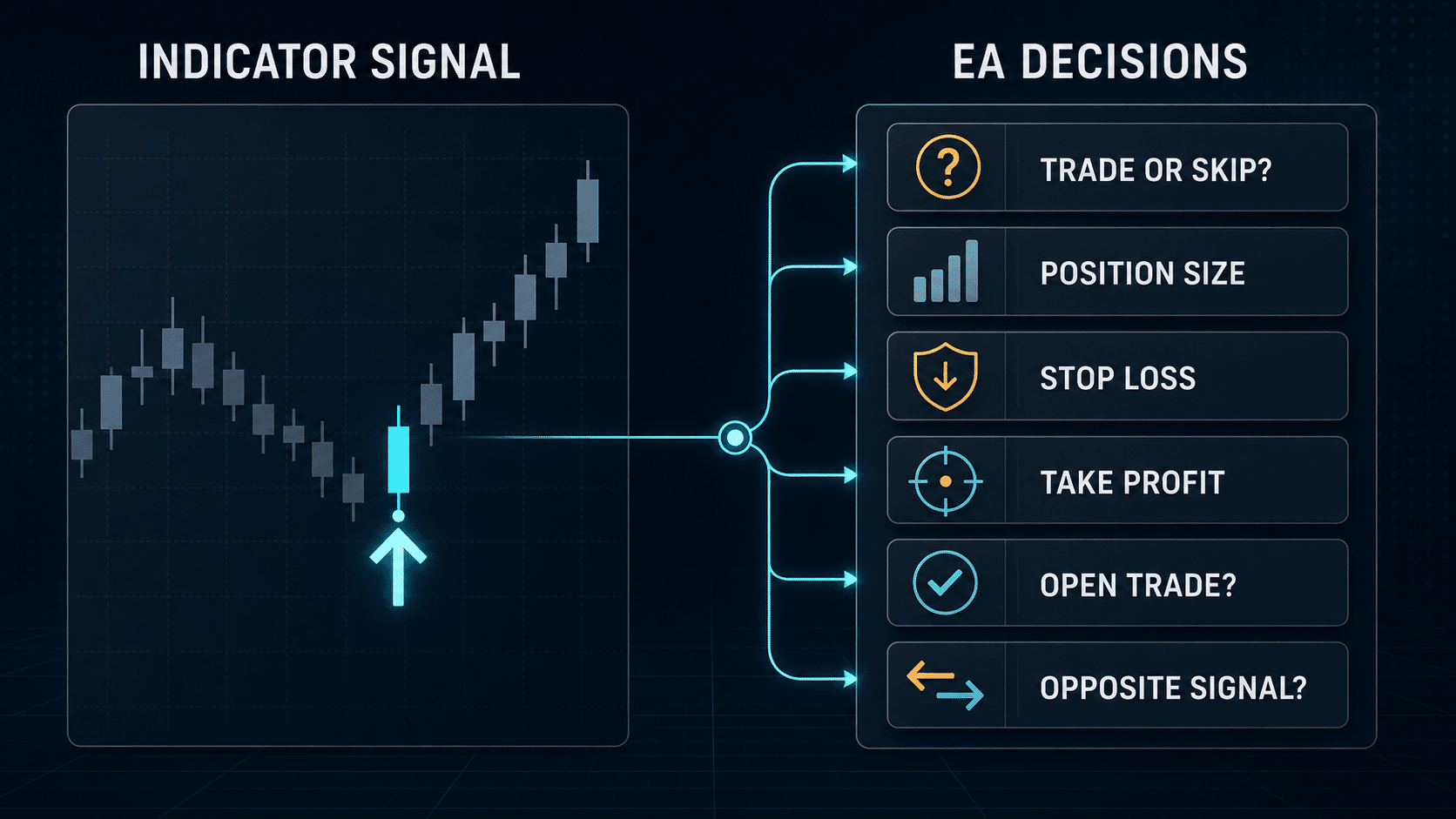
Two tools, two different jobs
An indicator observes. It looks at price and reports a condition. The trend is up. Momentum crossed. Here is an arrow. Its entire job ends the moment it has told you something. What you do with that information was always your problem, handled by your judgment, your risk sense, and your finger on the mouse.
An EA acts. It cannot stop at reporting a condition, because there is no human standing by to interpret it. The arrow is where an EA's job begins, not ends. It has to decide whether this particular arrow is worth acting on, how large a position to take, where the stop and target go, what to do about the position already open, and how to behave when the next arrow contradicts the last one.
None of those decisions live inside the indicator. They cannot, because the indicator was never asked them. When you convert an indicator to an EA, you are not translating code. You are supplying every decision the indicator never had to make, and that supply is the actual work.
The arrow that moves after you have acted on it
Here is the trap that catches more indicator conversions than any other, and almost no tutorial warns about it.
Many popular indicators repaint. The arrow appears on the current bar, you see a signal, and then price moves and the arrow shifts, or vanishes, or relocates to a bar where it now looks perfectly placed.
As a human reading the chart, you unconsciously waited for the bar to close before trusting it, so you never noticed the indicator was rewriting its own history.
An EA has no such instinct. It reads the buffer on the current forming bar, sees the arrow, and trades. Then the bar closes, the arrow moves, and the EA is holding a position based on a signal that no longer exists.
On the historical chart, everything looks flawless because the repainted arrows all sit in beautiful hindsight. In live trading, the EA acts on signals the past version of the chart showed and the final version erased.
This is why an indicator can look genuinely excellent by eye and produce a losing EA. The backtest inherits the lie. The only honest fix is to read signals from closed bars only, which changes the entry timing from what you saw on the chart, and sometimes reveals that the indicator's apparent edge was repainting all along.
That is a hard thing to discover after you have paid to automate it, and a good reason to check before.
The signals you filtered without noticing
Watch a trader use their own indicator, and you will see them ignore roughly half its signals. This one is against the trend, skip it. This one is in the middle of the session chop, skip it. This one came right before news, skip it. They are barely aware they are doing it. The indicator fired every time. Their judgment did the filtering.
An EA takes every signal the indicator gives, because you never told it which ones you would have skipped. This is the quiet killer of indicator conversions. The tool performs exactly as designed, fires exactly the signals it always fired, and the account bleeds through all the trades the human would have passed on.
The conversion did not fail. It succeeded at automating an indicator that was never meant to trade unfiltered.
Recovering those hidden filters is the bulk of a serious conversion. What trend context did you require? What times of day did you avoid? What had to line up before you trusted a signal? Every one of those has to become an explicit rule, and most traders have never written a single one down because they never needed to.
When the next signal disagrees with the last
An indicator has no memory of your account. It does not know you are already long. It just reports the next condition.
So the moment you automate it, you inherit a set of questions the indicator cannot answer. A buy arrow appears while you are already in a buy. Do you add, ignore it, or reset the stop?
A sell arrow appears while you are long. Do you close, reverse, or wait? Two signals fire on the same bar. Which wins? An indicator never had to resolve any of this, because you did, instantly and without thinking. An EA needs every branch defined, or it will do something, and the something it does by default is rarely what you wanted.
Why the universal converter EAs disappoint
There is a whole category of products that promise to trade any indicator through iCustom with a few settings. They work, in the narrow sense that they read the buffer and place trades. What they cannot do is supply the judgment layer, because that layer is different for every trader and every strategy.
So they hand you a generic set of knobs, a fixed stop, a fixed lot, take every signal, and call it automation. It is automation of the easy part, the reading, with none of the hard part, the deciding.
For a strategy that genuinely just trades every signal with a fixed stop, they are fine. For anything with real judgment behind it, which is most strategies worth automating, they reproduce the arrow and lose the trader.
What a real conversion involves
Properly turning an indicator into an EA is less about the indicator itself and more about everything around it.
The indicator supplies the trigger. The work is building the decision system the trigger feeds into: the entry filters you applied by eye, the position sizing, the stop and target logic, the handling of open trades when new signals arrive, and the discipline to read only confirmed, non-repainting signals.
If your indicator gives a clean, non-repainting signal and your strategy really is "trade every signal with a sensible stop," this is a modest job. If your indicator repaints, or you filtered its signals with judgment you have never written down, or your exits depend on feel, the conversion is where all of that hidden complexity finally has to become explicit, and that is worth knowing before anyone quotes you.
At Keenbase, we convert indicators into Expert Advisors for a living, and the first thing we do is check whether the indicator repaints and pull out the filtering rules you apply without realizing. Sometimes that check saves a trader from automating a signal that only looked good because it was reading ahead.
If you have an indicator you want trading on its own, please tell us how you actually trade it, and we will tell you what it will take to build.
You Might Also Like: