
Scalping EA Development: Most Strategies Are Dead Before You Code
Every scalping EA article ends in the same shopping list. Get a raw spread account. Rent a VPS. Sit close to the broker. All true, and all beside the point, because it treats execution quality as something you bolt on to a finished strategy.
It is not. For a scalping EA, execution cost is not an overhead. It is the opponent. Your strategy is not competing with the market; it is competing with a fixed toll charged on every single trade, and that toll is knowable in advance.
Most scalping ideas are already losing before anyone opens MetaEditor, and you can prove it on the back of an envelope in about five minutes.
Here is the arithmetic nobody does first
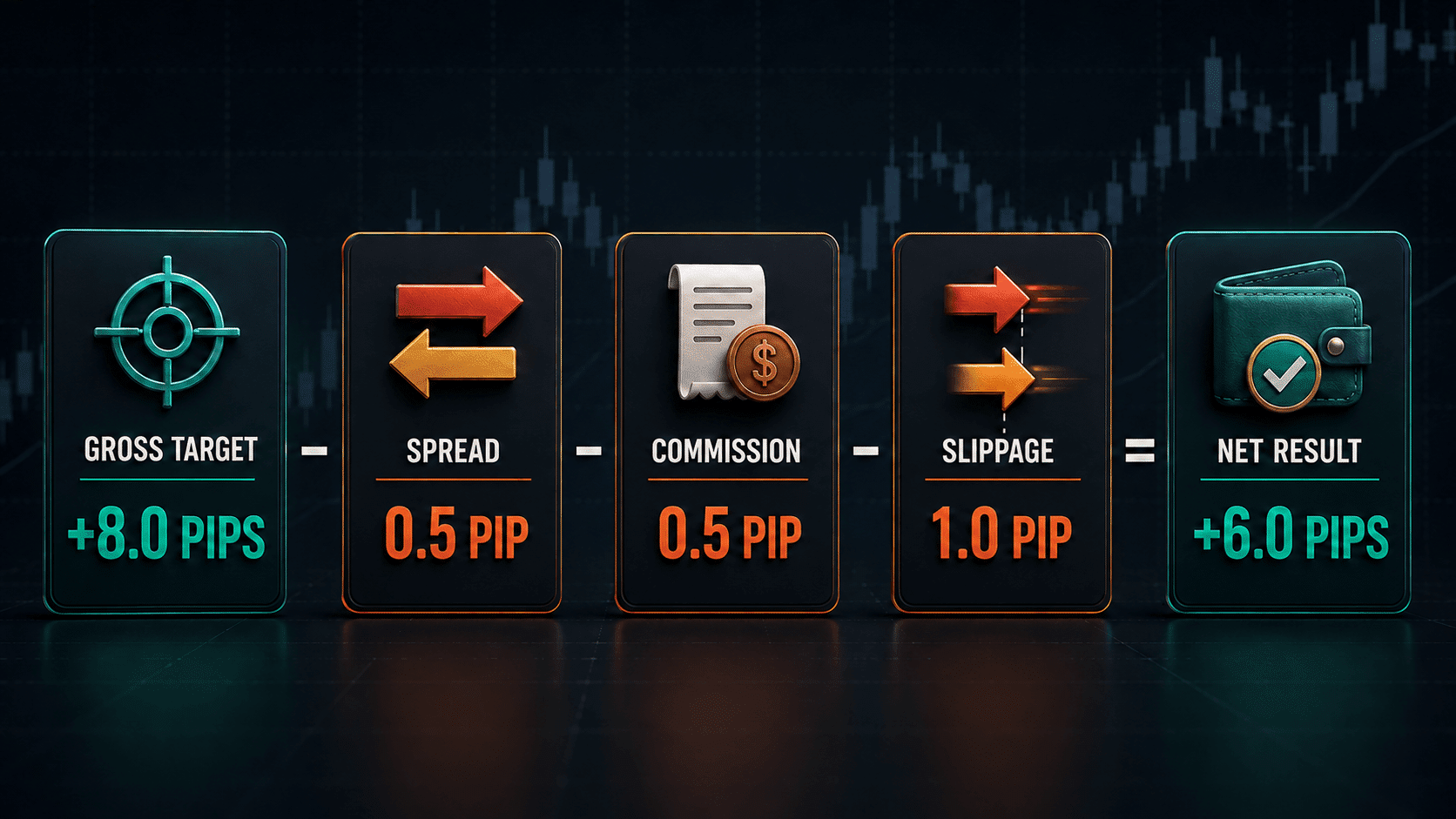
Your target has to clear the toll every time
Take a scalping strategy aiming for eight pips. Sounds modest and achievable.
Now subtract. Raw spread on a major during liquid hours, call it half a pip round trip if you are being generous. Commission on a raw account, roughly another half pip equivalent. Slippage on entry and exit, and this is the one people wave away, realistically another half to a full pip on a fast entry.
Your eight-pip target is now a five-and-a-half- to six-pip target, before the strategy has been right about anything. That toll is charged whether the trade wins or loses, so it hits your losers too, widening them by the same amount it shrinks your winners.
Run that across five hundred trades, and the difference between a good execution environment and a mediocre one is not a rounding error. A third of a pip of extra cost, compounded over that many trades on standard lot sizing, runs into four figures. The strategy did not change. The toll did.
This is why scalping is unforgiving in a way that swing trading is not. A strategy targeting two hundred pips barely notices a pip of cost. A strategy targeting eight pips is handing over most of its edge before it starts.
Run the numbers before the code
So the first question in any scalping EA build is not what indicators to use. It is this: what is my average target, what is my realistic all-in cost per trade, and what win rate do I need at that ratio to come out ahead?
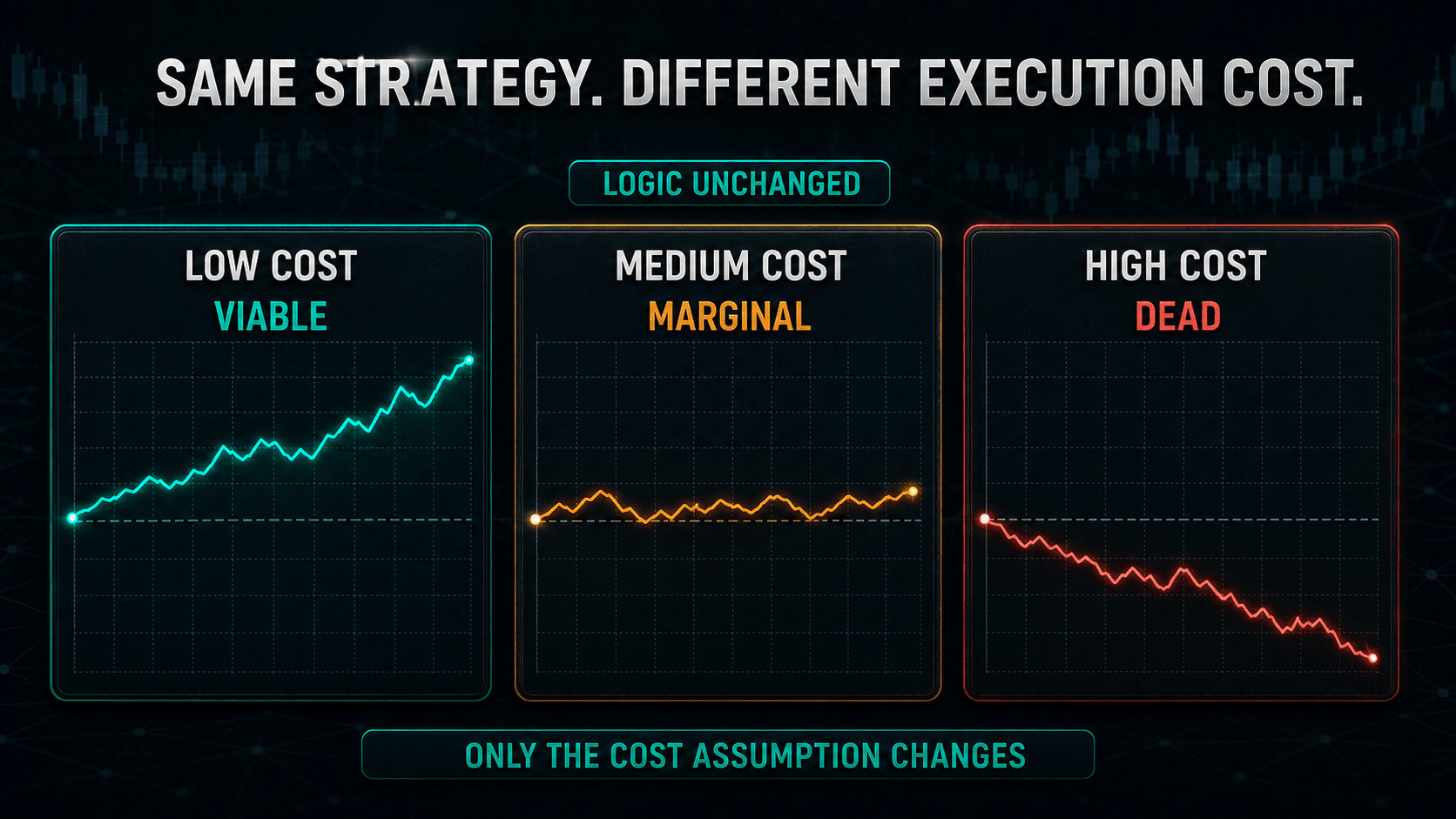
Do that subtraction honestly, and one of three things happens.
The strategy still works with room to spare. Good. Now build it, and the execution environment becomes an optimisation rather than a rescue.
The strategy works only in perfect conditions. This is the dangerous middle. It backtests beautifully, survives on a raw account with a colocated VPS, and dies the moment spreads widen, or you trade a slightly worse session. Worth knowing before you commission it, because the EA will be fine and the environment will kill it.
The strategy cannot clear the toll at any realistic cost. Then no amount of coding saves it, and the honest answer is to widen the targets until it clears, or trade a different idea. Nobody wants to hear this after paying for a build, which is exactly why it belongs at the start.
The protection you think you have
Here is a detail that even experienced scalpers find surprising, and it rarely appears in broker marketing.
MetaTrader's slippage deviation setting, the one that looks like slippage protection, does not protect you on market execution accounts. On those account types, the order fills at whatever the market offers when it arrives. The parameter is there, you can set it, and it will not save you from a bad fill.
Traders on ECN accounts routinely believe they have a slippage ceiling they do not have. For a strategy targeting eight pips, discovering this in live trading rather than in planning is an expensive lesson.
The platform is a bigger lever than the hosting
The other underrated variable is which platform you build on.
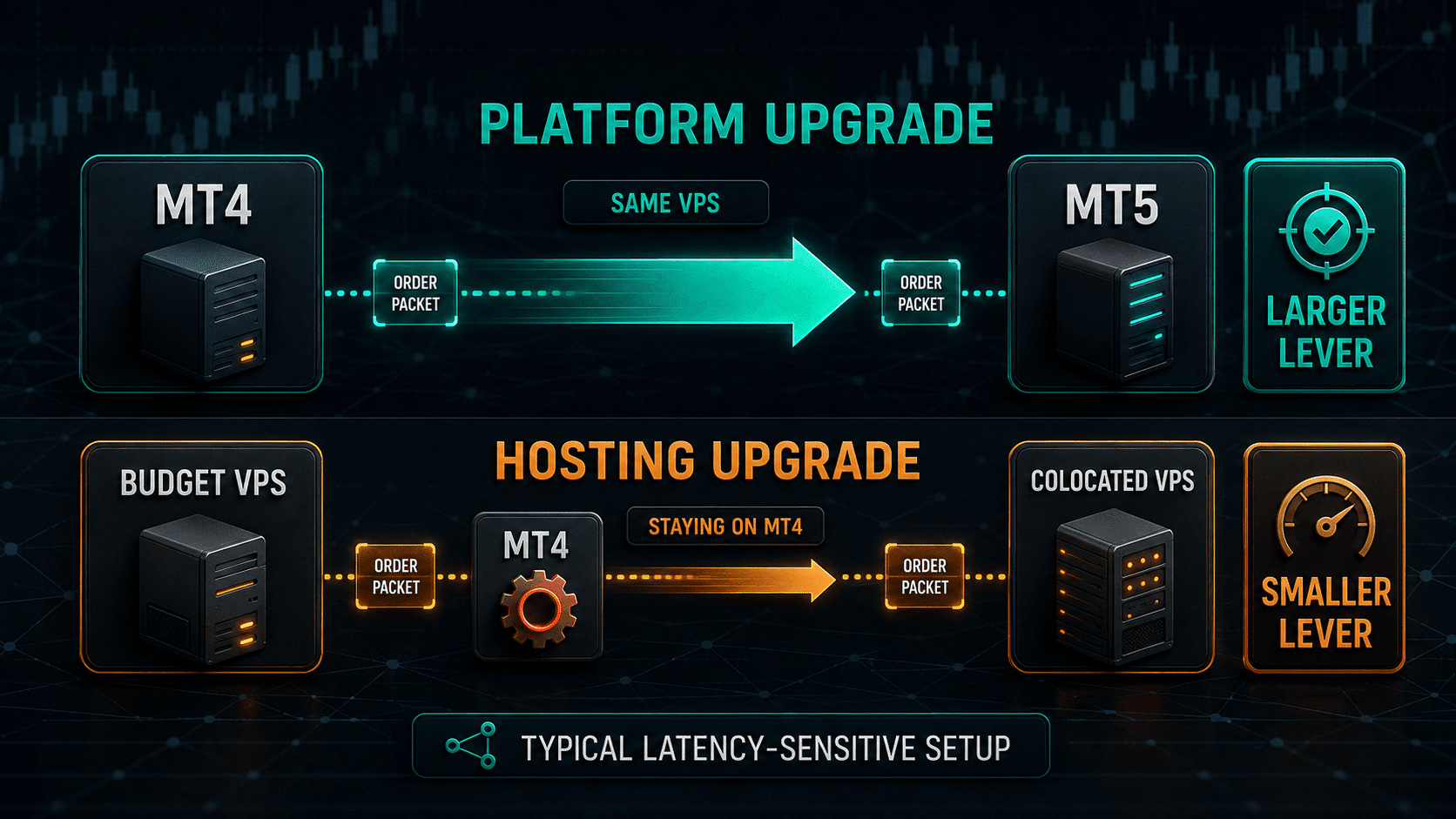
Broker-side order processing on MT5 runs dramatically faster than on MT4, and MT4 carries additional drag from how it handles order sending.
The practical result is counterintuitive: for many setups, moving a scalping EA from MT4 to MT5 on the same server delivers more execution improvement than upgrading from a budget VPS to an expensive colocated one while staying on MT4.
VPS providers sell milliseconds, and milliseconds do matter here. But if you are still on MT4 for a latency-sensitive strategy, the platform is the larger lever, and it is the cheaper one.
What a scalping EA needs that other EAs do not
Once the arithmetic clears and the environment is sound, a scalping EA still needs protections that a slower strategy can live without.
A spread filter is mandatory, not optional. The EA must refuse to enter when the spread exceeds the threshold your arithmetic assumed. Without it, the strategy trades in conditions where its own maths does not hold, which is a slow way to lose money while everything appears to be working.
Session awareness matters more than on any other strategy type. The same eight-pip target that clears comfortably during London runs into a wall in thin Asian hours when spreads widen. A scalping EA needs to know which hours its edge survives.
Stops and targets belong on the broker's server, placed the moment the position opens, so a disconnection does not leave a fast-moving position unmanaged.
And testing has to be tick level, with realistic spread modelling. A scalping strategy tested on bar data is not being tested at all, because everything that decides its fate happens inside the bar.
The uncomfortable summary
Most scalping EAs that fail did not fail because the logic was wrong. They failed because the logic was never given enough room to pay for its own execution, and nobody checked before building.
That check costs nothing: average target, all-in cost per trade, required win rate. Five minutes with a calculator tells you whether you have a strategy or an expensive way to pay spread.
We build scalping EAs at Keenbase, and the first thing we do on any scalping enquiry is run that subtraction with the trader before quoting.
Sometimes it saves them the cost of the build. When the numbers do clear, we build with the spread filter, session logic, and server-side protection baked in from the start, because on a strategy this cost-sensitive, those are not features; they are the difference between working and not.
If you have a scalping idea you want built, [send us the target and the rules, and we will run the numbers with you first].
You Might Also Like: