
Should You Hold Forex Trades Over the Weekend?
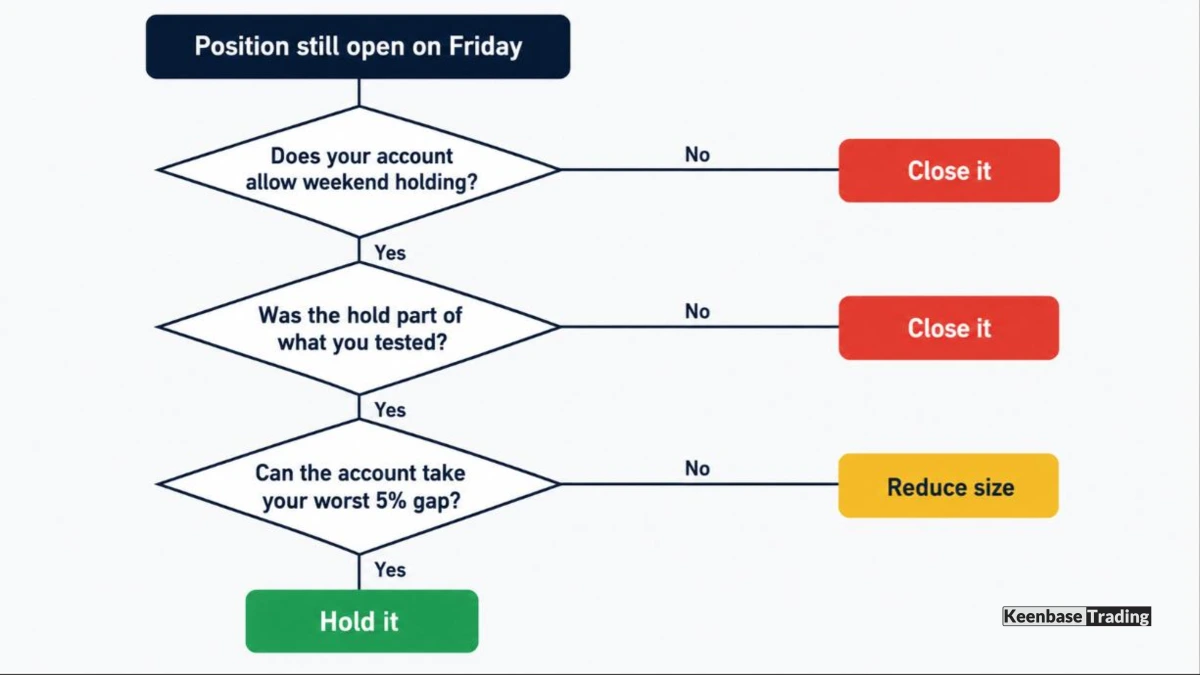
Hold the trade if two things are true: weekend exposure was part of the strategy you tested, and the position is small enough that a gap several times wider than your stop is survivable. If either is missing, close it.
Most answers to this question stop at the first condition and treat the second as a detail. It is the other way round. Whether the hold belongs to your strategy decides whether you should be in the trade at all. The size decides what happens when the weekend goes against you.
There is also a framing worth fixing before anything else. Closing on Friday is not a safety measure applied to your strategy. It is an exit rule, which makes it a different strategy, and it needs the same evidence as any other rule you trade.
Your Stop Is a Price, Not a Promise
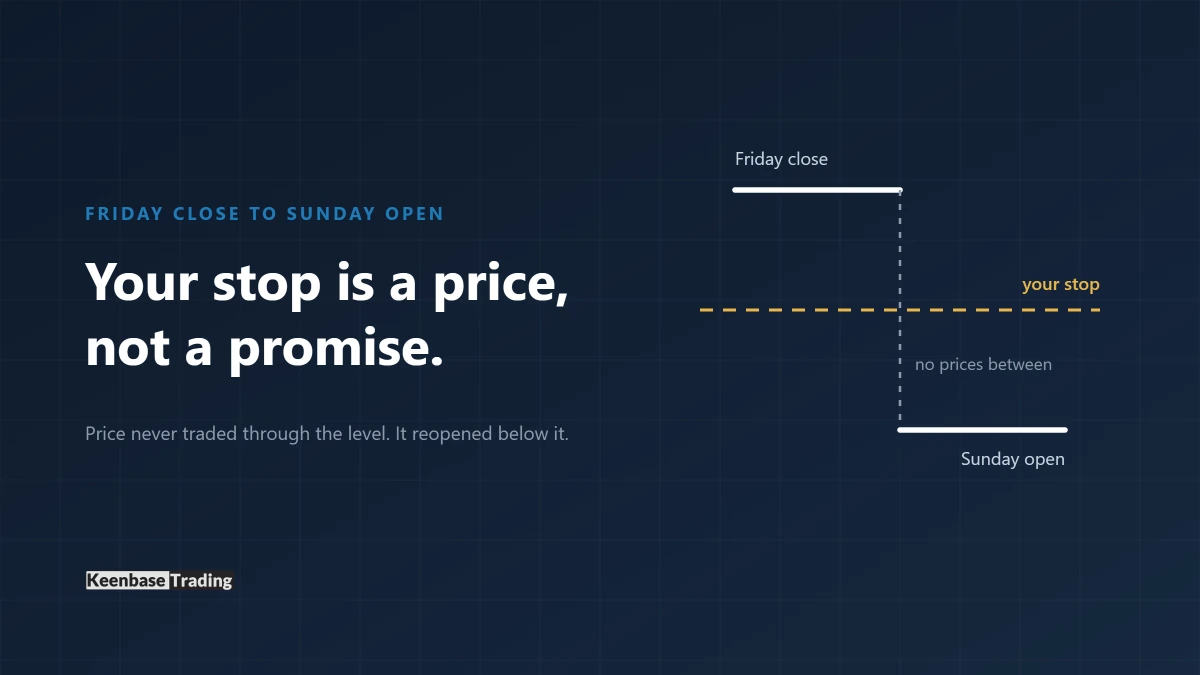
A stop loss is an instruction to close at market once a price is reached. It is not a contract to close at that price. During the week the difference rarely matters, because the market trades through your level and the fill lands a fraction away from it.
The weekend removes the trading-through part. Between the Friday close and the Sunday open there are no prices at all, so a stop sitting inside that range is not passed, it is skipped. The first price your order can meet is the opening price, wherever that turns out to be.
The same order therefore behaves differently depending on when it is hit. On a Tuesday, a stop 40 pips away costs roughly 40 pips. Over a weekend it costs whatever the gap is, and nothing on the chart tells you that number in advance.
The Arithmetic That Decides the Size
Risk on a normal trade is stop distance multiplied by position size. Over a weekend it is gap multiplied by position size, and only one of those two terms is yours.
Weekend loss = opening gap × position size
Run that through a position sized for 1% risk on a 40 pip stop and the result scales with the gap.
| Gap, as a multiple of your stop | Loss if you risked 1% | Loss if you risked 2% |
|---|---|---|
| 1× (40 pips) | 1% | 2% |
| 3× (120 pips) | 3% | 6% |
| 6× (240 pips) | 6% | 12% |
That table is arithmetic rather than a forecast. It says nothing about how likely a six times gap is on your symbol, only what one would cost. A trader risking 2% who meets a three times gap has lost a normal week in a single price print.
A trader who halves the position on Friday, meanwhile, has bought a two times gap for the same money. That is the whole of what sizing buys you here.
Because the number is arithmetic, you can stress it without waiting for history to supply the example. Take the positions you are holding, apply gap distances larger than anything in your data, and read off the account loss. The Keenbase pip value calculator turns a gap in pips into account currency for a given lot size.
The question is not whether that gap will happen. It is whether the account survives it if it does.
One correction to that sum. Your real weekend exposure is usually larger than the sum of your open stops, because several tickets can be one bet. Long EURUSD, long GBPUSD and short USDCHF are three positions and one view on the dollar.
A weekend event affecting the dollar moves all three together. Traders running several EAs meet this most often, since each strategy sizes sensibly against its own risk and none of them can see the total.
Closing on Friday Is a Different Strategy, Not a Safer One
Take a system that entered a multi-day trend on Thursday and still holds a valid position late on Friday. You can run it as designed, exiting when its normal condition occurs, or you can add a Friday exit. The second version is not a careful implementation of the first.
It is another strategy with a different return profile. The Friday exit avoids adverse gaps. It also gives up favourable ones, and it introduces a re-entry problem: the price on Monday may be worse, the spread and commission are paid again, and the entry condition that justified the trade may no longer exist.
Worse is the version most traders actually run, which is to decide on the day. Holding a Friday winner while closing a Friday loser is a state-dependent exit rule, and an untested one. If you have ever done that, the strategy you are trading is not the strategy you evaluated.
Reducing size before the close is a reasonable third option, and it is also a rule. Smaller exposure shrinks what a given gap costs, but it does not shrink the uncertainty, and it deserves the same test as the other two.
Testing them is a matter of running the same history twice and looking at what changed rather than at the bottom line:
- Run the original version, letting positions live across the weekend whenever their normal exit has not fired.
- Run a second version with a fixed cutoff in broker time. Make it deterministic, and do not let it decide based on whether the position is currently in profit.
- Do not add automatic Monday re-entry unless re-entry is genuinely the rule you intend to trade, because that is a third strategy again.
- Compare the two on the weekend-specific differences: profit and loss between the cutoff and the reopen, exits that landed beyond the intended stop, favourable gaps the flat version missed, positions that never produced another valid entry, the extra round-trip costs, and the change in worst trade and maximum drawdown.
The result decides the rule. If the hold version earns materially more and the account can take its gap tail, closing every Friday is removing part of the edge.
If almost none of the profit comes from weekend exposure while the worst losses get materially worse, flattening is easy to justify. Neither answer is safe to assume in advance.
The Costs Everyone Quotes Are Usually the Wrong Ones
Search this question and most answers arrive at swap, and specifically at triple swap. For spot forex that is generally wrong, and it is worth correcting because it sends people to worry about the smaller number.
Spot forex settles two business days forward, so a position held through Wednesday night carries a value date that lands on the weekend, and the interest for Saturday and Sunday is taken then. By Friday afternoon the weekend carry has already been charged, and holding from Friday to Sunday costs one ordinary swap.
The important part is that this is a per-symbol setting rather than a market-wide rule. The MQL5 symbol properties reference lists SYMBOL_SWAP_ROLLOVER3DAYS as the day of week on which the three-day rollover is charged, because it is a property of the symbol on your broker’s server.
Plenty of CFD instruments charge their triple on Friday. Open the symbol specification in MetaTrader and read it rather than assuming either version.
The cost that does bite is margin, and it bites at both ends of the break. FxPro states in its leverage information that instruments affected by a weekend break carry increased margin requirements for new orders in the hour before the close and the hour after the reopen.
In those windows its stated caps are 1:250 on forex, 1:200 on precious metals, 1:100 on indices and 1:50 on energy.
Read that carefully, because it applies to new orders rather than to the position you already hold. The trap is the combination. You come back to a gap that has taken a piece out of your equity, and for the first hour the leverage available to do anything about it is lower than the leverage you opened with.
Policies differ between brokers, so check your own rather than assuming either the windows or the figures.
What Else Moves the Answer
Symbol class matters more than most discussions allow. A major pair, an exotic cross, gold and a cash index behave differently at the Sunday open, and the ratio that decides your outcome is the gap measured against your own stop distance rather than the gap in pips.
The calendar matters too, and it is the one input that makes a specific weekend different from the distribution. Elections, referendums, emergency central bank statements and geopolitical decisions often land at a weekend precisely because markets are closed.
A gap distribution measured over two quiet years does not describe the weekend of a national vote. Finally, the question may not be yours to answer. Many funded accounts prohibit weekend holding outright, and prop firm rules change often, so confirm the current version with your provider.
Deciding Is Easy. Being There on Friday Night Is the Hard Part
Every consideration above is settled before the close, and none of them helps if you are away from the desk when the close arrives.
The close is also your broker’s Friday evening rather than yours. A rule expressed as flat by 22:00 means 22:00 on the server clock, which is not your local evening unless you happen to live in your broker’s timezone. The Keenbase GMT offset calculator reads the offset off your Market Watch if you have never checked.
KT Equity Protector EA turns the rule into a setting. It runs on a single chart in MT4 or MT5, opens no trades of its own, and monitors the whole account, so the rule sits above your manual trades and your other EAs together.
Its Weekend Close rule takes a Friday time in broker time, defaulting to 22:00, and acts on every position in scope when that time arrives.
You choose the action from the same set the other rules use: an alert, closing losers or winners only, closing everything, or closing everything and removing every other Expert Advisor from the terminal so nothing can reopen a position.
Scope filters matter more here than anywhere else in the product, because the weekend decision is rarely all or nothing.
If you run a swing system whose edge lives in Monday continuation alongside an intraday system that has no business being open on Sunday, symbol, magic number and comment filters let the rule close one and leave the other.
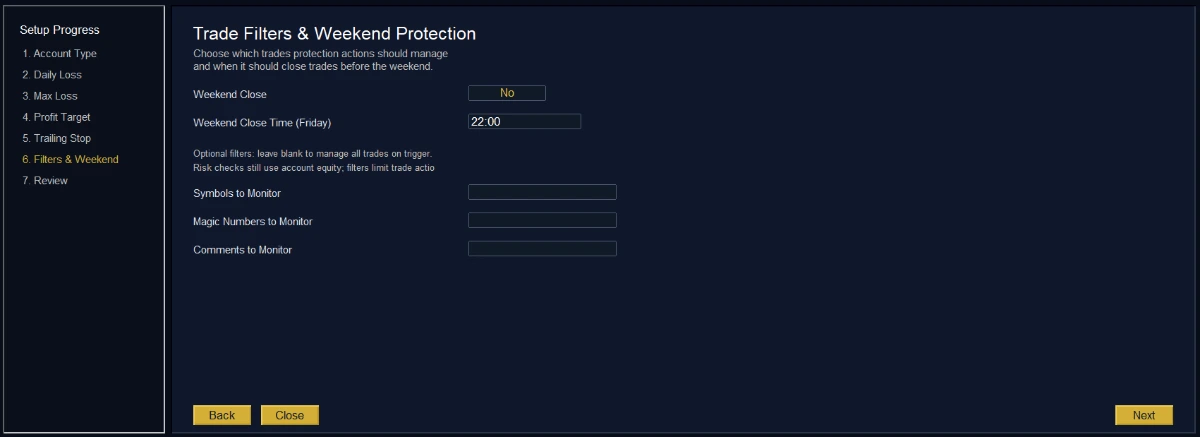
Pending orders are cancelled alongside positions, rejected close requests are retried, and every attempt is written to the daily CSV log, so a Monday post mortem starts from a record rather than a memory.
Set the cutoff while the instruments you want to close are still tradable. Session end times differ between symbols and between brokers, and a cutoff placed after your instrument stops quoting is a rule that cannot execute.
The limits are worth stating plainly. The EA cannot act while the terminal is closed or disconnected, which is the argument for a VPS rather than a laptop that goes into the boot of a car on Friday evening.
It also closes at the market price available at that moment, so it removes gap risk by removing the position rather than by improving a fill. And it will not tell you whether holding was the right call, only that the call you made was carried out.
Measure Your Own Gaps Before You Decide Anything
Most weekend advice argues about whether gaps are dangerous in the abstract. Your broker’s own data settles it for your symbols in an afternoon.
- Open a one minute chart of a symbol you actually trade and step back through it, recording the last price of each Friday session and the first price of the following session.
- Cover two years or more, so you have roughly a hundred weekends rather than a handful.
- Convert each gap into a multiple of the stop distance you normally use on that symbol, not into pips. Sixty pips means something different to a scalper and a swing trader.
- Sort the multiples and look at the worst five percent. The average weekend is irrelevant, because the average weekend was never going to hurt you.
- Multiply that tail by your usual risk and you have the number you are actually exposed to while you are asleep.
That figure is worth having because it is specific to your broker’s feed, your symbols and your stop distances. If it sits comfortably inside what you can lose in a week, holding is a reasonable choice and the swap is a rounding error.
If it does not, no amount of analysis on Friday afternoon fixes it, and the answer is a smaller position or a flat account. KT Equity Protector EA makes the second one a setting instead of a routine you have to remember.
Set your weekend close once and stop watching the clock
About this article
Published by Keenbase Trading. We have been trading since 2018 and build MetaTrader 4 and MetaTrader 5 indicators, Expert Advisors, free tools and custom development for traders.
Broker margin policies, swap settings and prop firm rules change often, so confirm the current version with your broker or firm before relying on any of them.