
Convert Pine Script to MQL5: What Survives and What Breaks
There is a moment in every TradingView-to-MetaTrader conversion where the trader asks the same question: it's eighteen lines, why is this not a twenty-minute job?
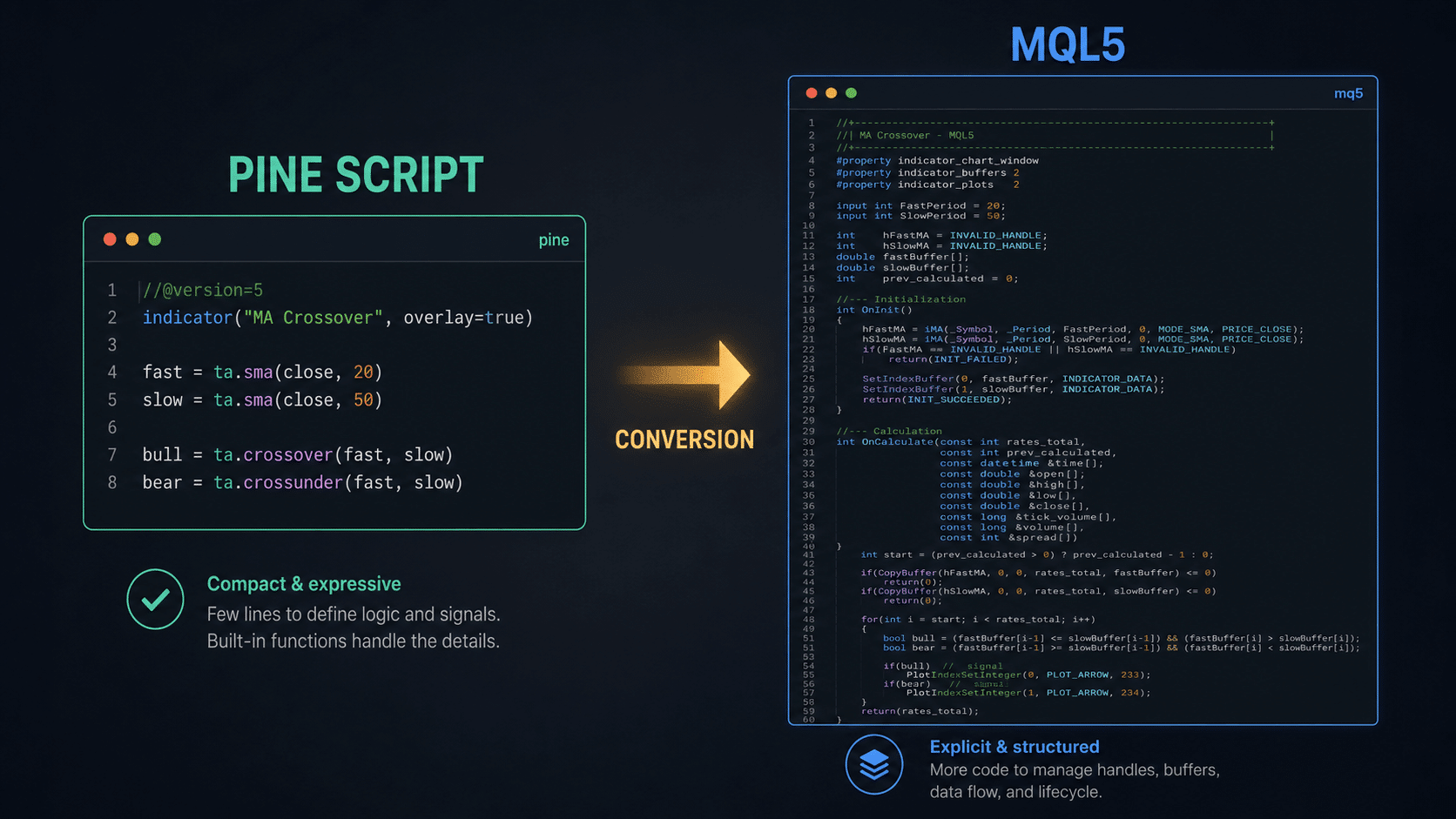
Fair question. The short answer is that the syntax converts in an afternoon and the behaviour does not, because Pine and MQL5 disagree about bar indexing, execution timing, higher-timeframe data and position management. Those disagreements are invisible until you go looking, and every one of them can produce a script that compiles cleanly and trades differently from the original.
Here is what actually happens to a script on the way across, piece by piece, so you know what you are paying for and where the risk sits.
Can a converter do it for you?
Not reliably, and the reason is specific rather than general.
Automated converters and AI prompts translate at the level of tokens and function names. They see ta.ema(close, 14) and emit an iMA call. What they cannot see is that Pine holds state across bars implicitly, that MQL5 arrays may be indexed in either direction, and that strategy.entry stands in for a position manager the target platform does not ship. Those are architectural facts about the two runtimes, not textual facts about the script, so a token-level translator has nothing to work with.
The practical result is a file that compiles and produces plausible-looking arrows in roughly the right region of the chart. That is the dangerous failure mode. Nothing errors, so nothing prompts you to check, and the divergence only shows up as unexplained slippage between the TradingView equity curve and the live account months later.
Converters are useful for one thing: producing a first-pass skeleton of the arithmetic so a developer does not have to retype every formula. Treat the output as a draft of the maths, not as a working script, and budget the same review time you would have spent writing it. The bar-by-bar comparison described further down is what tells you whether the architecture survived.
Your maths survives intact
The arithmetic transfers cleanly. A moving average is a moving average, an RSI period of 14 means the same thing on both platforms, and your crossover condition means what it meant before.
Expect small numerical drift, though. Built-in indicators differ slightly across platforms in how they seed initial values and handle edge cases, so your MQL5 version may print a value a hair off from the TradingView one. Exponential averages are the usual culprit, because the seed value depends on how far back the calculation starts, and the two platforms rarely start in the same place.
On a trend filter, this is noise. On a strategy that triggers when two lines sit within a few points of each other, that hair matters, and it is worth knowing which kind of strategy you have before anyone starts coding.
Your bar references get turned around
Pine counts backwards from now. close[1] is the previous bar, and the language handles history for you without being asked.
MQL5 makes you say what you mean, and the default is the opposite of what a Pine developer expects. Per the MetaQuotes documentation on indexing direction, the default indexing of all arrays and indicator buffers is left to right, so index zero is the oldest element unless you change it. Timeseries are the exception: they are indexed in reverse, so index zero is the current, still-forming bar.
The detail that catches people is that CopyBuffer and the rest of the Copy...() family always write data into the destination array oldest-element-first in physical memory, regardless of how that array is flagged. Calling ArraySetAsSeries(arr, true) does not move the data. It changes how the indices are addressed. So the same array can be read in either direction depending on one line you may or may not have written, and both readings compile.
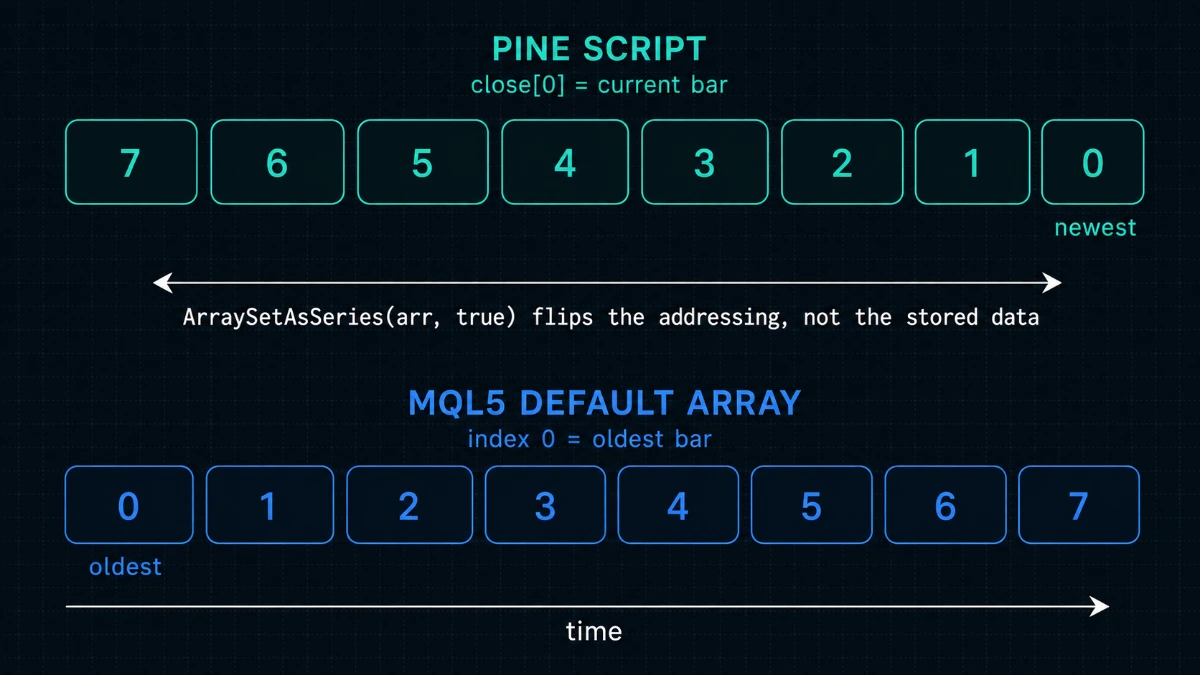
MetaQuotes are direct about the fix: ArraySetAsSeries() should be called unconditionally for any array you intend to work with, rather than relying on defaults. The arrays passed into OnCalculate are a particular trap, because their direction is not guaranteed and should be checked with ArrayGetAsSeries() rather than assumed.
Get this backwards and the code compiles happily, runs without complaint, and produces signals that reference the wrong candles. This is the single most common source of silent bugs in converted scripts. Nothing errors. The chart just fills with entries that look almost right, and it takes a careful comparison against the original to see that they fire a bar late or a bar early.
Your execution model gets replaced
Here is the deep one, and it is why the line count grows so much.
Pine runs top to bottom across the chart, bar by bar. Your script is one continuous piece of logic, and the platform walks it through history for you.
MQL5 does none of that. It waits. A tick arrives, and it runs OnTick. A new bar forms and your code has to notice, usually by storing the last bar time and comparing. Nothing runs unless an event fires, and your logic has to be broken apart and reassembled around those events. Variables that Pine remembered between bars for free now have to be declared as statics or class members and managed by hand. Indicator handles have to be created once in OnInit and released properly, not requested inside the tick handler.
So the conversion is not a translation. It is a rebuild of the same idea inside a different architecture, which is why token-level converters produce something that compiles and then behaves nothing like the original.
Expect the file to grow by a factor of two or three. Most of the additional code is not new logic. It is the event scaffolding, state handling and data copying that Pine performed silently on your behalf.
Your multi-timeframe calls need auditing, not just converting
If your script calls request.security to pull a higher timeframe, stop before converting anything and establish exactly how the original behaves on real-time bars.
TradingView's own documentation is worth reading here, because the popular version of this story is wrong in both directions. Their repainting page estimates that more than 95% of indicators in existence exhibit some form of repainting behaviour, and states plainly that not all of it is misleading. An RSI that updates on the forming bar repaints by that definition, and nobody sensible objects to it.
What matters for a conversion is which kind you have, because there are two distinct problems and they need different answers.
Unconfirmed higher-timeframe values: A plain request.security(syminfo.tickerid, "60", close) returns confirmed data on historical bars but fluctuating, unconfirmed data on real-time bars. When the chart reloads, those bars become historical and the values change. The backtest is honest. The live behaviour differs from it.
Genuine future leak: Using lookahead = barmerge.lookahead_on without offsetting the expression returns data from the future on historical bars. TradingView describe this as dangerously misleading and moderate published scripts that do it. This is the one that manufactures an edge that never existed.
The counterintuitive part, and the reason a lot of conversion briefs get this wrong, is that the non-repainting pattern documented by TradingView also uses lookahead_on. It requests expression[1] with lookahead = barmerge.lookahead_on, and both halves are required. Seeing lookahead_on in a script is therefore not evidence of anything on its own. You have to look at whether the series is offset.
Here is the part rarely mentioned in conversion guides: moving to MQL5 does not fix this for you. If the converted indicator calls CopyBuffer on a higher-timeframe handle and reads index 0, it is reading the current, still-forming higher-timeframe bar, which is the same unconfirmed value the Pine version was using. The signal will still shift during the hour and settle at the close. Reading index 1 instead gives you the last closed higher-timeframe bar and stable behaviour. It is one integer, it is invisible in the compiled file, and it decides whether your MT5 indicator repaints.
The genuine future leak is the one MQL5 will not reproduce, because the strategy tester walks forward and there is no future to read. So one of two things happens. Either the converted version underperforms the TradingView backtest and the trader assumes the conversion is broken, or an honest developer tells them the original was reading ahead and the edge was never real. The second conversation is uncomfortable and worth having before the invoice, not after.
Your strategy calls hide an entire engine
strategy.entry looks like one line. It is not.
Behind it sits a position management system that TradingView provides for free: pyramiding rules, automatic reversal when you flip direction, position sizing, order tracking, and the accounting that keeps it all coherent.
MQL5 gives you none of that. Every piece has to be written. Opening the position, tracking it, deciding what a second signal means while a trade is already running, handling the reversal, placing the stop and target, and dealing with partial fills, requotes and minimum stop distances that TradingView's simplified fill model never had to think about. Netting versus hedging account modes add another layer, because on a netting account a second buy adds to the existing position rather than opening a separate one, which changes what pyramiding even means.
This is why converting an indicator is a modest job and converting a strategy is a real one. The indicator draws. The strategy trades, and trading is where the platform's hidden helpfulness stops being available.
If what you are holding is a Pine strategy rather than an indicator, that position-management layer is most of the invoice, and it is the part worth scoping before you agree a price. We build it as a matter of routine on our custom MetaTrader development projects, and we will tell you which pieces your specific script actually needs.
Your backtest will not match, and that is not a bug
Once it runs, the numbers will differ from TradingView. Four things stack up, and they are worth separating because only one of them indicates a fault.
Different data: Your MT5 broker's feed is not TradingView's feed. Different spreads, different session boundaries, different tick history.
Different history length: TradingView caps chart history by account plan, from 5,000 bars on entry-level plans up to 40,000 on the highest tier, and the starting bar shifts over time depending on timeframe alignment. Any calculation with memory, including EMAs and anything using ta.barssince, is affected by where the dataset begins. MT5 will happily run the same script over a far longer history with a different warm-up. Two backtests over the same nominal period often are not.
Different fill modelling: TradingView's broker emulator assumes how price moved inside each bar unless Bar Magnifier is enabled, which is a paid-plan feature. When a stop and a target could both be hit inside one candle, the emulator has to guess the order. MT5 models the bar from tick data, and which modelling mode you choose (real ticks, generated ticks, or 1 minute OHLC) changes the answer materially.
Small indicator variation: the seeding differences described earlier.
A modest gap in profit factor is normal and expected. A large one means something is wrong in the logic and needs finding. Occasionally the MQL5 version does better, because tick simulation catches intrabar entries the bar-level model never saw. If you are unsure how to read the difference, this walkthrough of an EA backtest report covers what the numbers actually mean.
The comparison that actually finds the bug
Comparing equity curves tells you that something is different. Comparing entries tells you what. The procedure is reproducible and worth running before anyone signs off a conversion.
Pick a symbol and a fixed date range that exists on both platforms, and use a timeframe of H1 or higher so the bar timestamps are unambiguous. Strip both versions down to signal generation only: no stops, no targets, no position sizing. You are comparing when the logic fires, not what it earns. On TradingView, plot a marker or print each signal's bar time to the Pine log and export the list. In MT5, write each signal's bar time to a CSV with FileWrite. Then line the two lists up by timestamp.
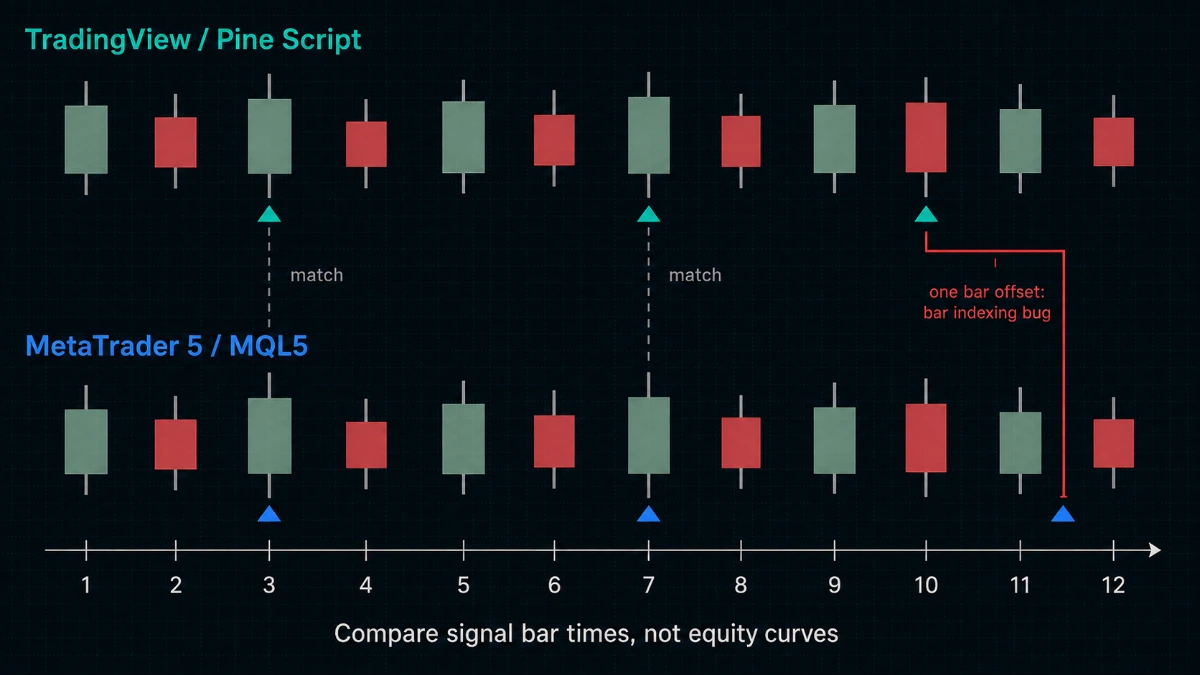
Three outcomes, three diagnoses. If the MQL5 signals are consistently one bar later or earlier than the Pine ones, the bug is bar indexing or a closed-versus-forming bar condition. If MQL5 produces a subset of the Pine signals, the Pine version is probably firing on unconfirmed data that MQL5 is correctly refusing to act on. If the signals match on historical bars but diverge in forward testing, the higher-timeframe handling is reading an unclosed bar.
Only once the entries line up is there any point comparing profit figures.
If your target is MT4 rather than MT5
Plenty of traders searching for an MQL5 conversion are actually running MT4, and the two targets are not the same job.
MQL4 is closer to Pine in one respect: iMA and friends return a value directly rather than a handle, and buffers are series-indexed by default, so the bar-indexing trap largely disappears. It is further away in others. There is no built-in higher-timeframe handle system, order handling is ticket-based rather than position-based, and MT4's tester runs a single symbol with no real tick data.
If you have not yet committed to a platform, decide before the conversion rather than after, because the position-management layer is where most of the work sits and it does not port between MQL4 and MQL5 cleanly.
What to send us, and what you get back
If you have a Pine indicator you want on your MetaTrader charts, that is usually a clean job. Plot logic, alerts, buffers, done.
If you have a Pine strategy you want trading live, you are ordering a rebuild, and five questions decide the scope. Does the original call request.security, and if so, is the expression offset by [1]? Does it rely on strategy calls with pyramiding or reversal behaviour? Does it trigger on bar close, or intrabar with calc_on_every_tick? Does it use varip or timenow, neither of which has a historical equivalent? And is the target MT4 or MT5, on a netting or a hedging account?
Each of those answers changes the scope, and any developer who does not ask them is guessing at your quote.
We convert Pine Script and TradingView work to both MQL4 and MQL5 at Keenbase. Send us the source and, before any money changes hands, you get back a written read of the script: which of the traps above it contains, whether the higher-timeframe logic is honest, what the MetaTrader version can and cannot reproduce, and a fixed quote for the actual job rather than the line count.
Sometimes that read saves a trader from paying to automate a strategy that only ever looked profitable because it was reading ahead. More often it just means nobody is surprised later. Either way the assessment costs nothing.
Send us your Pine script for a free assessment
Common questions
Is there a free Pine Script to MQL5 converter that works? There are free AI prompts and paid online converters, and they will produce compilable MQL5 from simple Pine. None of them reliably rebuild the event architecture, position management or higher-timeframe handling, because those are properties of the runtime rather than of the source text. Use them for the arithmetic, then verify the signals bar by bar before trusting anything.
Can Pine Script run directly in MetaTrader? No. Pine executes only inside TradingView's environment. Any use on an MT4 or MT5 chart requires a rewrite in MQL4 or MQL5.
How long does a conversion take? An indicator with plot logic and alerts is typically a short job. A strategy with position management, higher-timeframe filters and reversal handling is a rebuild, and the honest range depends almost entirely on the five questions above rather than on the original line count.
Will the converted version repaint? It will if the higher-timeframe data is read from the still-forming bar, and it will not if it reads the last closed bar. That is a coding decision made during the conversion, not something inherited automatically. Ask for it explicitly in the brief.
You Might Also Like: