
A Beginner Guide to Risk Management in Forex
Risk management in forex is one decision, made before you enter: how much money you lose if you are wrong.
Everything else, the stop loss, the lot size, the leverage setting, is machinery that delivers that number. Decide it first and the rest is arithmetic. Pick a lot size first and discover the loss afterwards, and no strategy will rescue the account.
The scale of the problem is documented. In its 2018 product intervention decision, ESMA reported that national regulators’ analyses across EU jurisdictions found 74% to 89% of retail accounts typically lose money, with average losses per client between 1,600 and 29,000 euros.
What follows is the order of operations, and the arithmetic at each step.
Step 1: decide the money, not the lots
Before you look at a lot size, write down what you are willing to lose on this trade if it fails, in your account currency, as a number.
Why the order matters: a lot size chosen first is a bet on how much you would like to make. A loss amount chosen first is a decision about what you can survive. They produce very different positions.
On a $1,000 account, 2% is $20. That $20 is now fixed. It does not grow because the setup looks unusually good.
Step 2: put the stop where the idea is wrong
The stop does not belong at a distance that feels comfortable. It belongs at the price that proves your reason for entering was mistaken.
If the idea was that a level would hold, the stop sits beyond that level. If it was a breakout continuing, it sits back inside the range. The chart decides the distance, not your appetite.
This is the step beginners most often invert. They pick a stop distance that produces the lot size they wanted, which puts the stop where their sizing is comfortable rather than where their analysis is disproved.
Step 3: let those two numbers produce the lot size
Only now does position size appear, and it is not a choice. It falls out of the two decisions you already made.
÷ (stop distance in pips × pip value per lot)
Worked through on a $1,000 account, risking 2% on EURUSD with a 30 pip stop and a pip value of $10 per pip per standard lot:
You cannot trade 0.0667 lots. Brokers accept volume in steps, commonly 0.01. So the theoretical answer has to be rounded to something you can actually enter, and the direction matters.
Rounding down to 0.06 lots gives 30 × $10 × 0.06 = $18 of planned loss. Rounding up to 0.07 gives $21. If $20 was genuinely your maximum, only one of those is correct.
Always round down. Rounding up quietly breaks the limit you just set, and it does so on every trade.
The pip value is the other thing people get wrong. It is money per pip per lot, not a number of pips. The $10 figure assumes a standard lot of 100,000 units on a USD-quoted pair with a USD account. Other pairs and other account currencies differ, so take the real figure from your platform.
Step 4: size from equity, not balance, when trades are already open
Balance reflects completed transactions. Equity also includes the current value of everything still open. MetaTrader reports them as separate account properties for exactly that reason.
With nothing open, the two are effectively the same and it does not matter which you size from.
With floating losses already on the account, sizing a new trade from balance makes your account look less exposed than it is. Equity is the more conservative base, and the point is to pick one method and apply it consistently rather than switching when it flatters the position you want.
Step 5: derive your risk percentage instead of accepting one
Advice to “never risk more than 3%” sounds precise, but the number cannot be derived without saying how much drawdown you will tolerate and how long a losing run you expect.
Work backwards instead. If you recalculate risk from current equity after each trade, what remains after a run of full losses is:
Ten consecutive losses at 1% leave about 90% of the account and need roughly 11% to recover. At 2% they leave 82% and need 22%. At 5%, 60% and 67%. At 10%, about 35% and roughly 187%.
Notice what the 10% row does not say. Risking 10% of current equity does not wipe the account out in ten losses. It leaves about a third. The reason it is still reckless is the recovery, not the ruin.
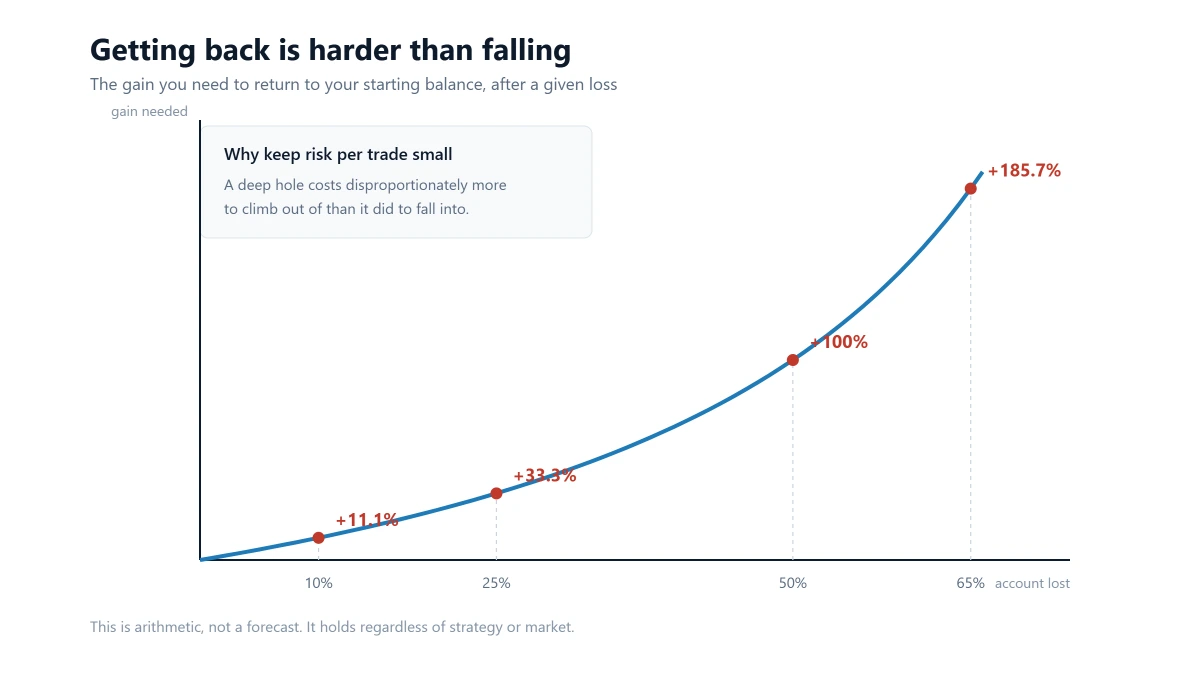
Recovery is not symmetrical with loss. Down 10% needs 11% back. Down 25% needs 33%. Down 50% needs 100%. That asymmetry is the entire argument for small risk per trade, and it is arithmetic rather than caution.
You can also reverse it. If you want ten consecutive losses to cost no more than 20% of the account, the constant risk that satisfies it is 1 − 0.80^(1/10), or about 2.2% of current equity per trade.
That is not a recommendation, and it is a calculation rather than a backtest. It tells you what a chosen drawdown tolerance implies. Your own testing should tell you whether ten losses in a row is even the right assumption.
One caution on the formula: it assumes you recalculate from current equity each time. Risking a fixed cash amount set at 10% of the original account behaves very differently, and ten full losses of it would consume the original capital.
Step 6: leverage is not your risk
This is the correction that matters most, because most beginner material gets it backwards.
Leverage does not determine your loss. Position size does.
Alice’s account is set to 30:1 and Bob’s to 100:1. Both open 0.50 lots of EURUSD. Price moves 50 pips against them. Both lose about $250. The move is the move and the size is the size.
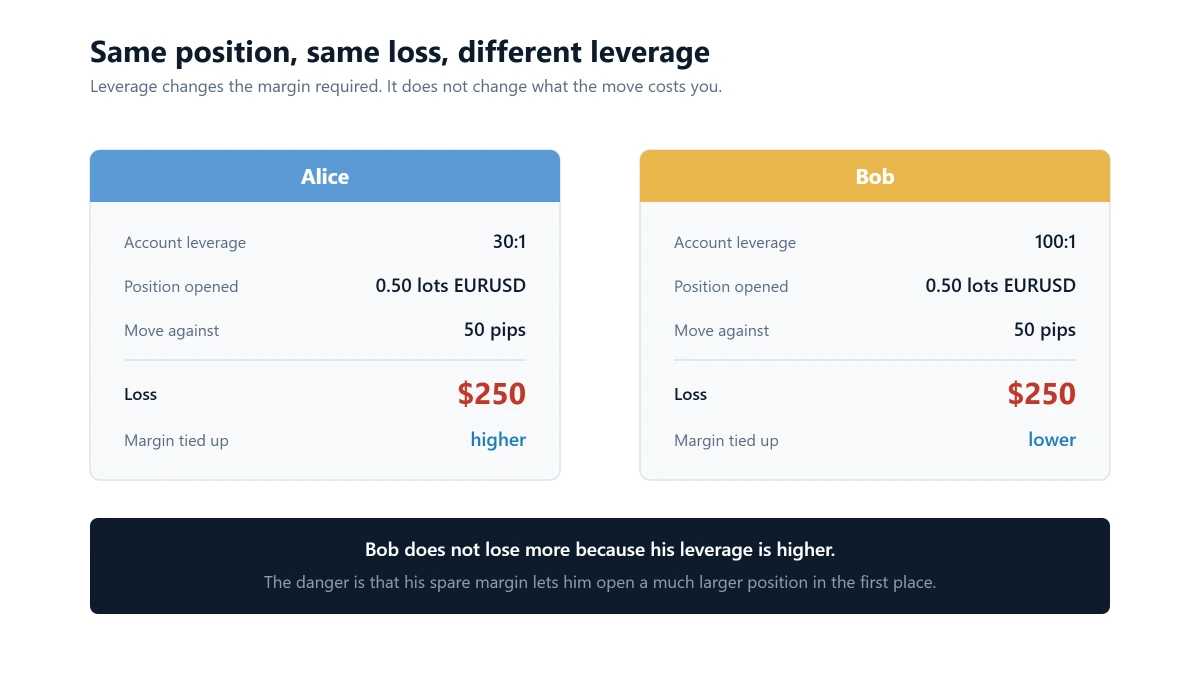
What leverage actually controls is margin: how much of your equity is locked up to hold the position. Bob’s higher leverage means he ties up less to hold the same 0.50 lots.
So where is the danger? In what Bob does with the spare margin. If he opens 5.00 lots where Alice opens 0.50, he loses ten times more, because his position is ten times larger, not because his leverage ratio multiplied anything.
That is also why regulators capped it. ESMA set retail limits of 30:1 on major currency pairs and 20:1 on non-majors, alongside a margin close out rule at 50% of required margin and negative balance protection on a per account basis.
Leverage is not the risk. It is the permission slip for taking too much of it. If your position size comes out of Step 3, your leverage setting barely matters.
Your stop is planned risk, not a promised loss
The calculation above assumes the position closes at the stop price. Real execution can differ.
A gap, a fast market or thin liquidity can fill you somewhere else. Spread, commission and swap are separate from the price movement the formula measures, and they come out of the same account.
So treat a $20 calculated risk as a planned figure, not a guarantee that the account cannot lose $21.
One trade sized correctly is not an account sized correctly
Suppose a $5,000 account holds two trades, each risking $50 to its stop. Open risk is $100, or 2%.
Add three more of the same and the account carries $250 of open risk, or 5%, even though every position was described as a 1% trade.
Correlation makes it worse. Long EURUSD and long GBPUSD are two different pairs but largely one bet against the dollar. They can lose together on a single move, so the account risk is closer to their sum than to the largest of them.
You therefore need two numbers, not one: what a single position loses at its stop, and what the account loses if every open stop is hit.
Daily and account limits answer different questions
A stop answers what one trade can lose. A daily loss limit answers what all of today’s trading can lose. A maximum drawdown rule answers at what account-level loss you stop entirely, whatever caused it.
These are separate controls solving separate problems. You can size every trade correctly and still blow past your intended daily loss after five stopped trades, and a run of individually acceptable days can add up to a drawdown that is not.
Decide both numbers before the session, when nothing is at stake. The moment you most need the limit is exactly the moment you will most want to renegotiate it.
Where automation fits
Steps 1 to 3 are yours. No software can decide where your idea is wrong or how much you can afford to lose.
The account-level limits are different, because a rule you enforce by watching fails when you step away or when the move is faster than you are.
KT Equity Protector EA enforces that layer on MT4 and MT5. It does not open trades or choose direction. It attaches to one chart, watches the whole account, and acts when a line you set is crossed, closing positions and cancelling pending orders.
Its daily loss rule can anchor to start-of-day balance or equity, or the previous close of either, and its max loss rule to the initial balance or a trailing peak, with a safety buffer so it acts before the number you actually care about.
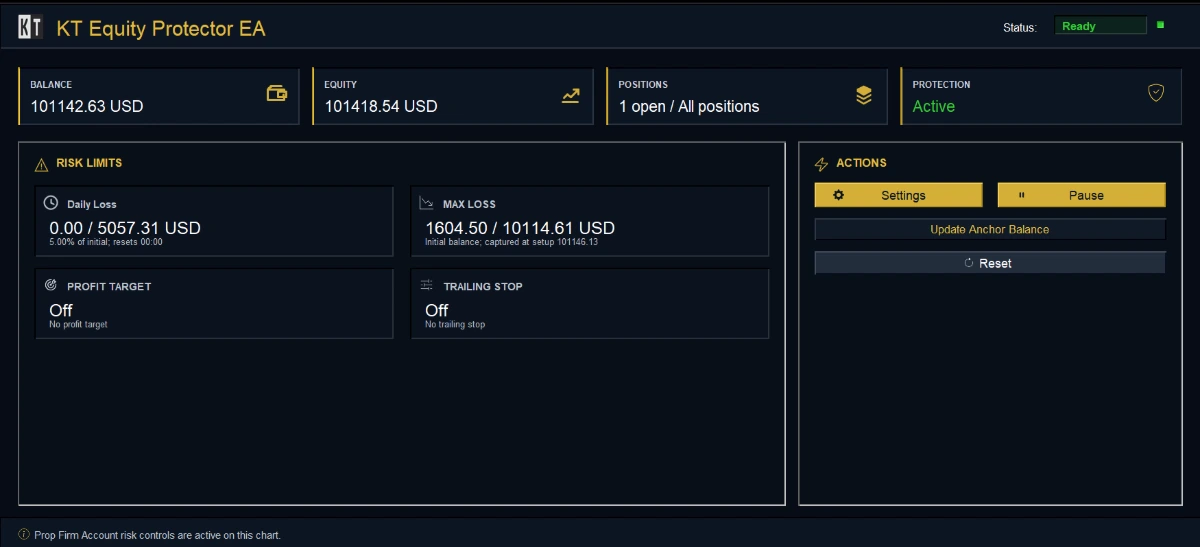
Every trigger and close attempt is written to a dated CSV, and after a breach the account holds a reset-required state until you clear it deliberately.
What it cannot do: choose your position size, and act while MetaTrader is closed. The second is the argument for a VPS if the protection needs to be continuous.
The order of operations, in one place
- Find the invalidation price: where the trade idea is wrong, decided before you enter.
- Measure the stop distance: the pips between entry and that price.
- Decide the money: what this trade is allowed to cost.
- Calculate the lot size: the money divided by the stop distance times the pip value, rounded down.
- Check the account: add this trade’s risk to what is already open, and to your daily limit.
Only after those five does a lot size mean anything.
That is risk management in forex. Not an attempt to avoid losing trades, but a decision made in advance about what being wrong is allowed to cost.
Enforce your account limits with KT Equity Protector EA
About this article
Published by Keenbase Trading. We have been trading since 2018 and we build MetaTrader 4 and MetaTrader 5 indicators, Expert Advisors, free tools and custom development, including the account protection EA discussed above.
Pip values, lot steps, leverage caps and margin rules differ between brokers and jurisdictions, so confirm the figures that apply to your own account before sizing a trade from them.