
Daily Profit Target in Trading: Should You Stop After Hitting Your Goal?
Stop at a daily profit target only if you can name the failure it prevents. “Protecting my gains” is not an answer, because the gains are already yours. Closing the platform does not make them more yours, and the next setup has the same edge it had an hour ago.
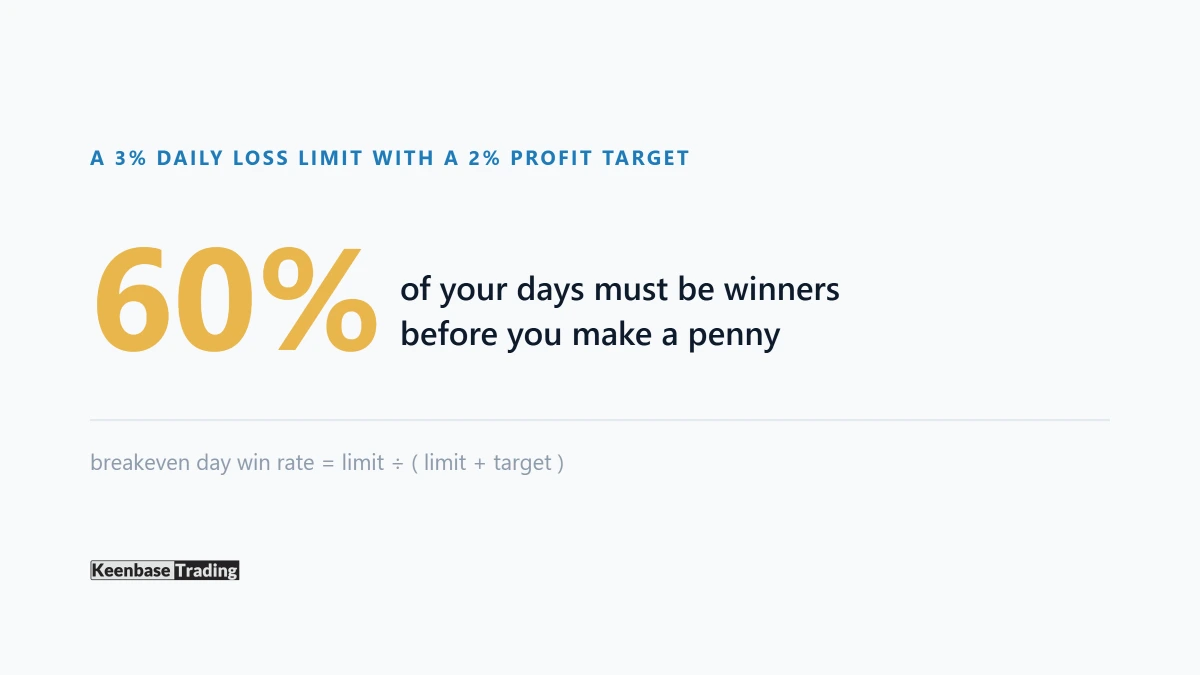
What a target does do is measurable, and most traders have never measured it. Almost everyone running a profit target also runs a daily loss limit, and the two together quietly impose a win rate on your days.
3% limit, 2% target → 3 ÷ 5 = 60% of days must be winners
3% limit, 6% target → 3 ÷ 9 = 33% of days must be winners
Cap the day at plus 2% while allowing minus 3% and you have committed to winning three days in five before you make a penny. Nobody chooses that. It arrives by picking two round numbers on separate afternoons.
So the useful question is not what your target should be. It is which failure the rule is for, because there are three candidates and only one of them is best solved by a target.
A Profit Target Cuts the Side of the Distribution You Need
Your losses are bounded by design. Every trade carries a stop, so a bad day is the sum of a limited number of limited losses. Winning days have no equivalent ceiling, which is the point of trading a positive expectancy method: the good days are allowed to run.
A daily profit target removes that asymmetry, and it removes it from the side you need. It converts an open right tail into a fixed one and leaves the left tail exactly where it was.
That matters more than it sounds, because most positive expectancy records are not evenly distributed. A minority of days carry the year, and those are precisely the days a target truncates first, since a strong day reaches the target early and then sits on its hands.
The formula above describes the extreme case where both rules bind and every day ends at one edge or the other. Real days finish in between, so read 60% as the boundary of what you have signed up to rather than as a prediction. The direction of the effect does not change.
The Failure a Target Actually Prevents
There is a real problem here, and it is worth separating from the vague one. It is not that you fail to protect gains. It is that a winning day turns into a losing day.
That happens for reasons the arithmetic does not capture, and they are all about the person rather than the market. After a good start, size creeps up without a reason from the strategy. Marginal setups start to look acceptable because the day’s profit feels like a cushion.
Trades come more often, ending the session gets harder, and a normal loss becomes an attempt to get back to the day’s peak. Whether that describes you is a question about your own record rather than about trading in general, and a later section is how to answer it.
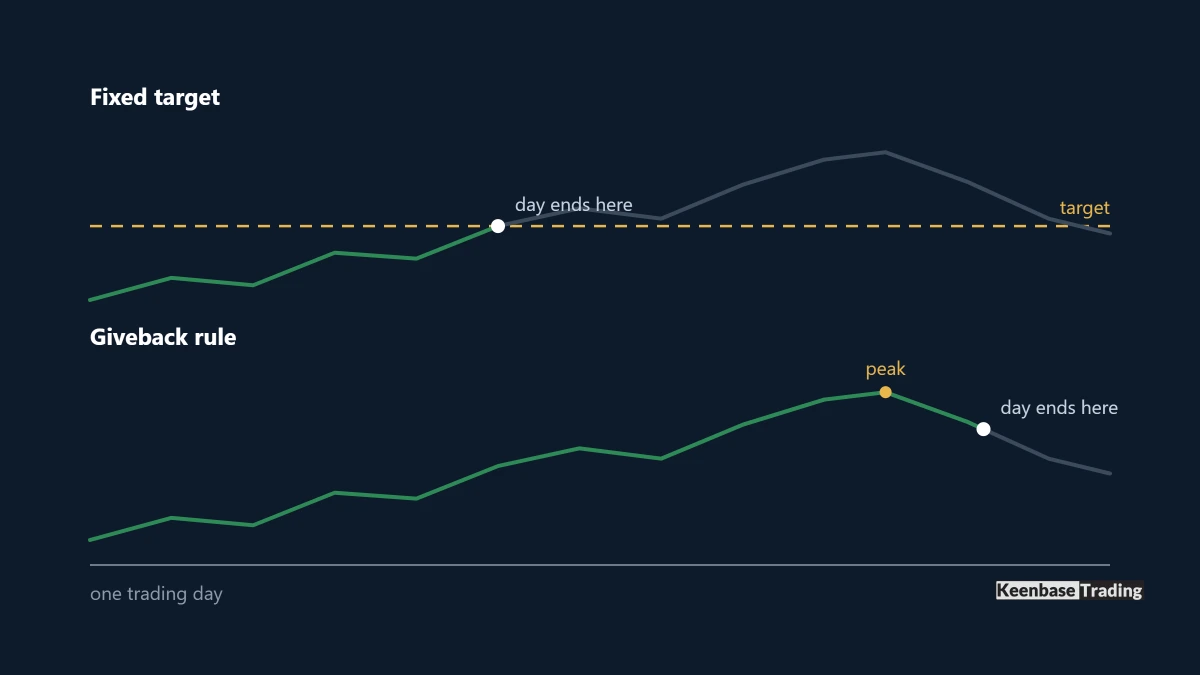
A target says stop at plus 2%. A giveback rule says once you are up, stop when you hand back too much of it. Only one of those two closes the day that was about to reverse.
The distinction is the whole article. A fixed target fires on a level you set in advance, which means it fires on good days and never on bad ones. A giveback rule fires on a reversal, which means it leaves a day that keeps running alone and closes the day that turns.
Both stop a winning day becoming a losing day. Only the second leaves the right tail open, and the right tail is where the year is.
Your Target May Be Measuring the Clock Rather Than the Money
Before crediting any target with anything, there is a confound worth ruling out, and it runs in both directions.
Suppose you usually reach your goal near the end of your best trading window. A test on your history will show that stopping at the target works, and the benefit will have come from stopping at that hour rather than at that number. The target is a proxy for the clock.
Now suppose the opposite, that your target is mostly reached on unusually directional sessions. Those are the days with the most opportunity still in them, so the same rule is cutting you off precisely when the market is paying. The target is a proxy for the regime.
A profit threshold correlates with time of day and with market state, and neither of those is what you meant to trade. Test a time-based cutoff separately from the P&L one before concluding that the money level is doing the work.
Where a Fixed Target Is Genuinely Right
Three situations, and outside them the giveback rule is usually the better tool.
When the payoff is a step function: on a prop firm challenge, passing is binary. Once the balance is above the target with positions closed, further profit buys nothing while further variance can cost the account.
FTMO’s trading objectives put the Challenge target at 10% of initial capital, with 5% on the Verification phase of the two-step version, against a maximum loss of 10%. At the target, every additional trade risks the whole thing to win nothing.
When the target is what stops a rule breach: this one is not obvious and it inverts the usual advice. FTMO’s Best Day Rule requires that your single best day is no more than 50% of your positive days’ profit on the 1-Step Challenge and on the FTMO Account. A day that is too good becomes a problem you have to trade your way out of.
Follow that arithmetic and a trader who makes the entire 10% target in one day needs twice that in positive days’ profit before the account qualifies. Stopping a strong day early is not caution there, it is compliance.
That follows from the rule as published rather than from a test, and firm rules change often, so read the current version with your own provider before building anything around it.
When your own record says so: the version that applies to a personal account, and the only one that can settle the behavioural question above.
The Trap Is Usually in the Number, Not the Idea
A target smaller than your average winning day fires on ordinary days. If your good days run to 3% and you cap at 2%, the rule is not catching excess, it is catching normal. You will hit it constantly, which feels like success and is a haircut applied to every good day you have.
A percentage moves while a currency amount does not. Two percent of a growing account is a different figure every month, which is usually what you want, but only if the anchor is the balance you are actually trading rather than a number from the day you opened the account.
Decide which of the two you mean rather than inheriting a default.
How to Settle It From Your Own History
Take your trades in their original order and run the day twice. Compute cumulative profit and loss trade by trade, find the first point at which the proposed target would have been reached, and remove every later trade from that version of the day.
Then run the same history again with a giveback rule instead, and compare all three sequences rather than just the totals: what happened to profitable days, to losing days, to the giveback inside winning sessions, and to the concentration of return in your strongest days.
One thing to separate as you go. Post-target trades that followed your plan and post-target trades taken out of boredom or confidence are different populations, and they point at different rules.
If the plan-compliant ones still earn, a hard target is cutting your edge. If they earn but the undisciplined ones erase them, the target is a behavioural circuit breaker and it is doing a real job.
Be honest about what this test can prove. For a mechanical system the reconstruction is clean, because the signals reproduce. For a discretionary trader it is evidence rather than proof, since your decisions after the target would themselves have been different had you known you were about to stop.
Making It a Rule Rather Than a Resolution
A decision that lives only in your intentions gets tested at the moment you are least able to make it, which is when the platform is open and the day is going well.
KT Equity Protector EA runs both rules, and running both is the configuration this article argues for. It sits on a single chart in MT4 or MT5, opens no trades of its own, and watches the whole account rather than the positions on its own chart.
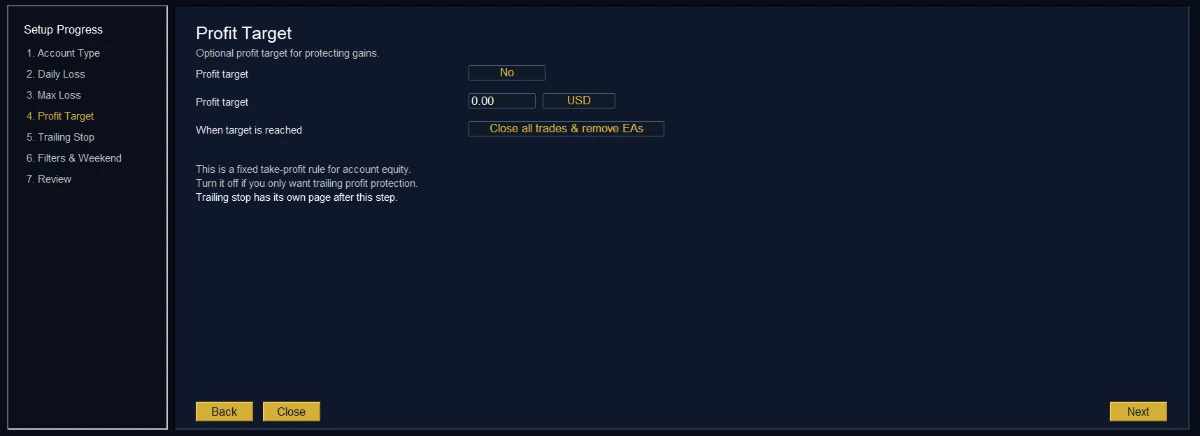
Its Profit Target rule takes a percentage gain or a fixed currency amount, anchored to either the initial balance or a custom starting balance you set. That anchor choice is the fix for the second trap above.
Its Equity Trailing Stop is the giveback rule. You set how far up the account must be before the trail arms, and how much of the peak you are willing to hand back before it fires.
It works on account equity rather than on individual trades, and it survives platform restarts, broker disconnects and chart switches.
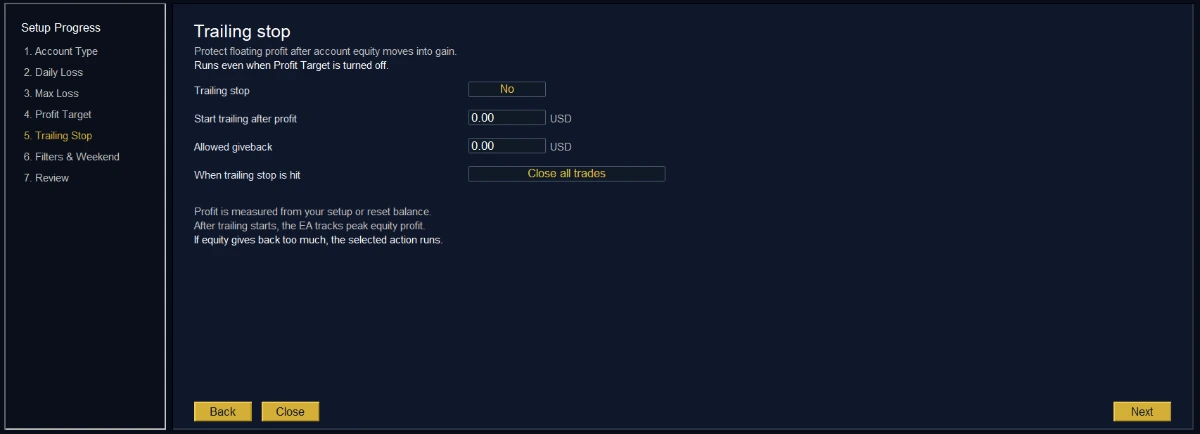
The two are independent, which the setup screens state plainly: the profit target step notes that you can turn it off if you only want trailing protection, and the trailing stop step notes that it runs even when the profit target is off.
So you can have either alone or both, and both together is the arrangement worth understanding. The target sets a level at which the day is definitely over, and the trailing stop closes anything that turns before it gets there.
When either rule fires you choose what happens, from an alert through to closing every position and removing every other Expert Advisor from the terminal. Pending orders are cancelled alongside positions, rejected closes are retried, and every trigger is written to a daily CSV log. Where two rules fire at once, the strongest action wins.
Three honest limits. Removing the other EAs stops software reopening a position, but nothing in the action set stops you placing one by hand.
The profit target is anchored to a starting balance, and the supplied information does not describe it resetting each calendar day, so do not assume a daily reset if your tested rule needs one. And none of it runs while the terminal is closed or disconnected, which is the argument for a VPS.
The number still has to come from your own record. What the software changes is whether the number you chose is the one that actually applies at four o’clock on a day that is going well.
Set your profit target and your giveback rule once
About this article
Published by Keenbase Trading. We have been trading since 2018 and build MetaTrader 4 and MetaTrader 5 indicators, Expert Advisors, free tools and custom development for traders.
Prop firm rules change often, so check the current objectives with your firm before building any stopping rule around them.