
Why We Do Not Build Martingale EAs (and What We Build Instead)
We turn down martingale EA development requests, and it costs us work. Traders arrive with a grid or recovery system they want built, sometimes with a backtest attached that looks better than anything else they own, and we say no. It seems precious, so it is worth explaining properly, because the reason is not the one people expect.
The objection is not that martingale systems lose money. Plenty of them make money for months or years. The objection is that they destroy your ability to know anything about whether they are working, and that is a worse problem than losing.
Why the curve looks so good
Start with why these systems are seductive, because dismissing that is dishonest.
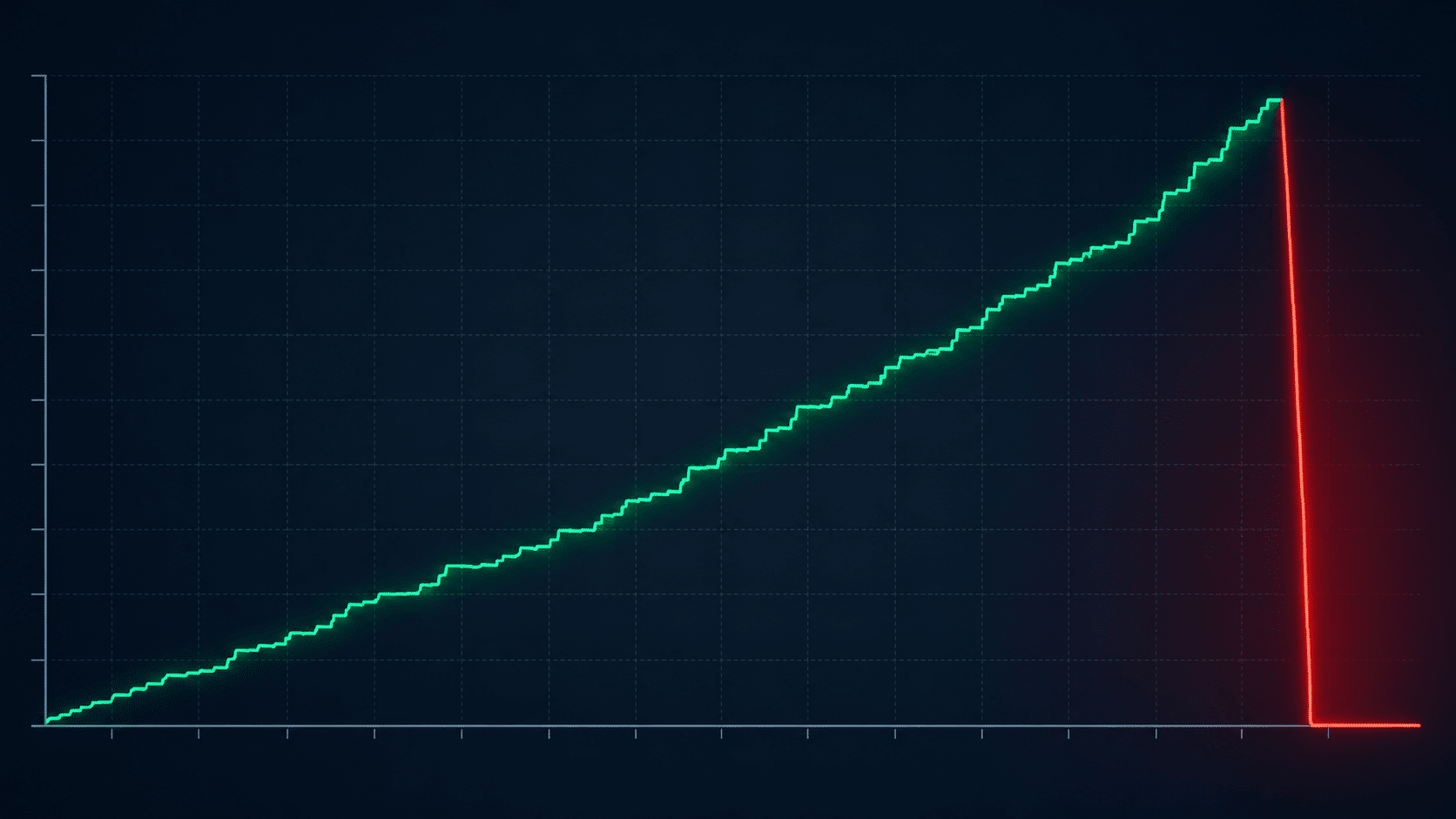
A martingale EA increases position size after a loss. A grid EA adds positions at intervals as price moves against it. Both share one property that makes them feel extraordinary: individual losing trades mostly stop existing. A losing position is not closed at a loss; it is held and averaged, and the basket eventually closes green when price retraces even slightly.
The result is an equity curve with almost no visible losses, a win rate in the high seventies or eighties, and a profit factor that makes conventional strategies look broken. Traders see this and reasonably conclude they have found something. What they have actually found is a system that converts many small realised losses into one large unrealised one, and defers it.
The deferral is not a bug the developer failed to fix. It is the entire mechanism.
The genuinely counterintuitive part
Here is what most warnings about martingales get wrong. They say it will blow up eventually, which sounds like a distant risk you can manage by watching carefully.
The mathematics says something more uncomfortable. MetaQuotes' own foundational treatment of these strategies, published in the MQL5 article library, works through the equations and concludes that pure grid and martingale systems are, in the long run, losing strategies, whatever they do in the short term.
Later academic work sharpened the point: Taranto and Khan gave grid trading its first rigorous mathematical treatment and named the result the Sustainability Paradox.
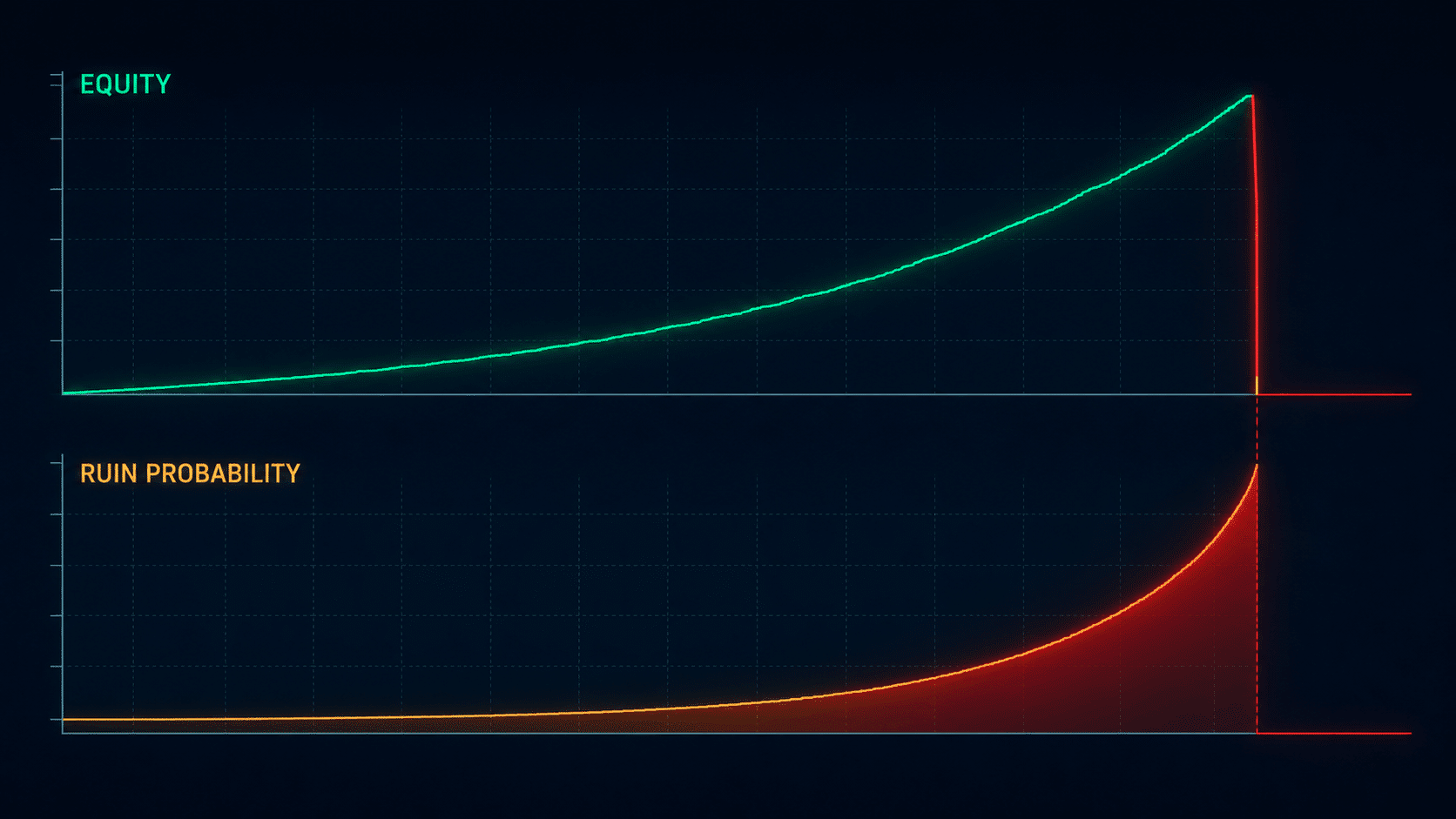
Grid systems generate superior short-term returns while the probability of eventual ruin approaches certainty. Both findings describe the same trap. The chance of catastrophic loss climbs steadily as the system runs, but the equity curve stays almost flat before collapsing sharply.
The practical meaning is brutal: the system looks equally safe at every level right up until it is not. There is no gradual deterioration to notice, no warning sign in the results, no month where the numbers get slightly worse and tip you off.
This is why blow-ups feel sudden to the people they happen to. The risk was rising the whole time, and it was mathematically invisible in the equity curve. You cannot monitor your way out of it, because the thing you would monitor does not change until it is over.
Every metric you would judge it by is uninformative
The second problem follows from the first. The numbers you would normally use to evaluate an EA do not carry information here.
Take drawdown. On a conventional strategy, maximum drawdown tells you something real about the logic.
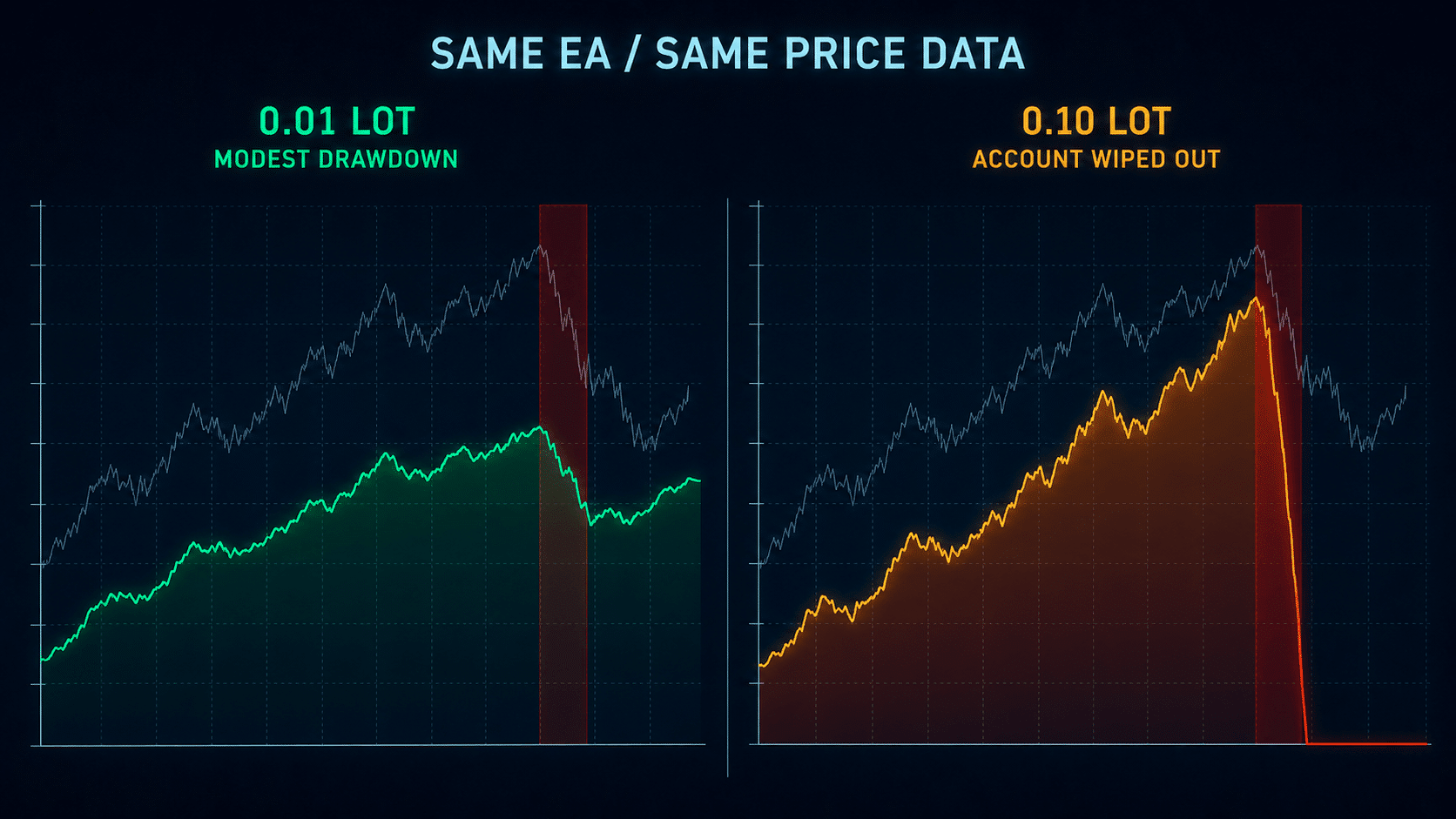
On a martingale system, drawdown is mostly a function of lot size. Independent reviews of these products make the point repeatedly: the same EA on the same price data shows a modest drawdown at a tiny fixed lot and wipes the account at a size a trader might reasonably choose. The logic did not change. The reported figure is describing the settings, not the strategy.
The same applies to win rate, profit factor, and the length of a live track record. A three-year live record on a martingale EA does not demonstrate robustness. It demonstrates that the specific sequence of market conditions in those three years did not include the move that ends it.
Reviewers know this, which is why honest reviews of these products keep landing on some version of "profitable, but a single event can wipe it out," which is a strange thing to call profitable.
So when a trader shows us a backtest and asks us to build something similar, the honest answer is that the backtest is not evidence. Not because it is faked, but because this class of system produces good-looking results whether or not it is sound, which makes the results useless for telling the two apart.
Grid and martingale are not the same thing
This is where blanket condemnation becomes lazy, and it is worth being precise.
A pure martingale multiplies size after losses. The expected value works against you, and no amount of clever entry logic repairs it, because the mechanism itself is the problem.
A grid places fixed-size orders at intervals. That is a mathematically different animal, and this is the part the academic work actually established. Taranto and Khan proved the common assumption wrong: a grid is not just a martingale wearing a different skin, but a distinct process with a different loss accumulation rate.
The same analysis shows that a constrained grid, with a hard cap on levels, a portfolio level stop, and genuine entry logic rather than blind spacing, behaves differently from the naive version. Its worst case can be calculated in advance, and it can be operated deliberately.
The distinction matters because it identifies what actually makes these systems dangerous, and it is not the averaging. It is the absence of a defined worst case. A system with a hard cap on exposure and an enforced stop is a system whose maximum loss you can state before you start. A system without one is a bet that the market will not do something it has done before.
Prop firms have landed on exactly this line, and they have the account data to justify it. Most major firms ban martingale-style size increases outright while permitting fixed size grids that respect daily loss limits. They are not being philosophical. They are pricing risk from what actually happens to accounts.
What we build instead
When someone comes to us wanting a recovery system, the conversation we have is about what they are actually after. Usually it is not martingale specifically. It is the feeling of a smooth equity curve and few visible losses, which is an understandable thing to want.
So we build toward that honestly. Defined risk on every position, so the worst case is known and stated. Portfolio-level limits that stop everything if cumulative loss hits a threshold, rather than letting a basket run. Strategies whose results are boring enough to be informative, where a modest win rate and a modest profit factor tell you something true, because nothing is hiding losses inside unrealised positions.
That is a less exciting backtest. It is also a backtest that means something, and a system where a bad month is a bad month rather than a countdown.
If a client understands all of this and still wants a constrained grid with hard caps and an enforced portfolio stop, that is a legitimate build, and we will discuss it on those terms. What we will not build is an uncapped averaging system with no defined worst case, because we would be selling something whose risk cannot be stated, and we would rather lose the project.
If you have a strategy you want automated and you want to know what its actual worst case is before you run it, tell us what you trade, and we will build it with the risk defined.
You Might Also Like: