
How to Automate a Trading Strategy That Actually Works by Hand
You have a strategy. You have traded it for months, maybe years. You know the setup when it appears, you know when to stay out, and the account has grown. So you reach the obvious conclusion: hand the whole thing to an EA, let it run day and night, and stop staring at charts. Then you try, or you pay someone to try, and the automated version trades nothing as you do.
This is the most common gap we see in custom development, and it is worth understanding before you spend a dollar building anything. The problem is rarely the coding. The problem is that your strategy, as it lives in your head, is not yet a strategy a computer can follow.
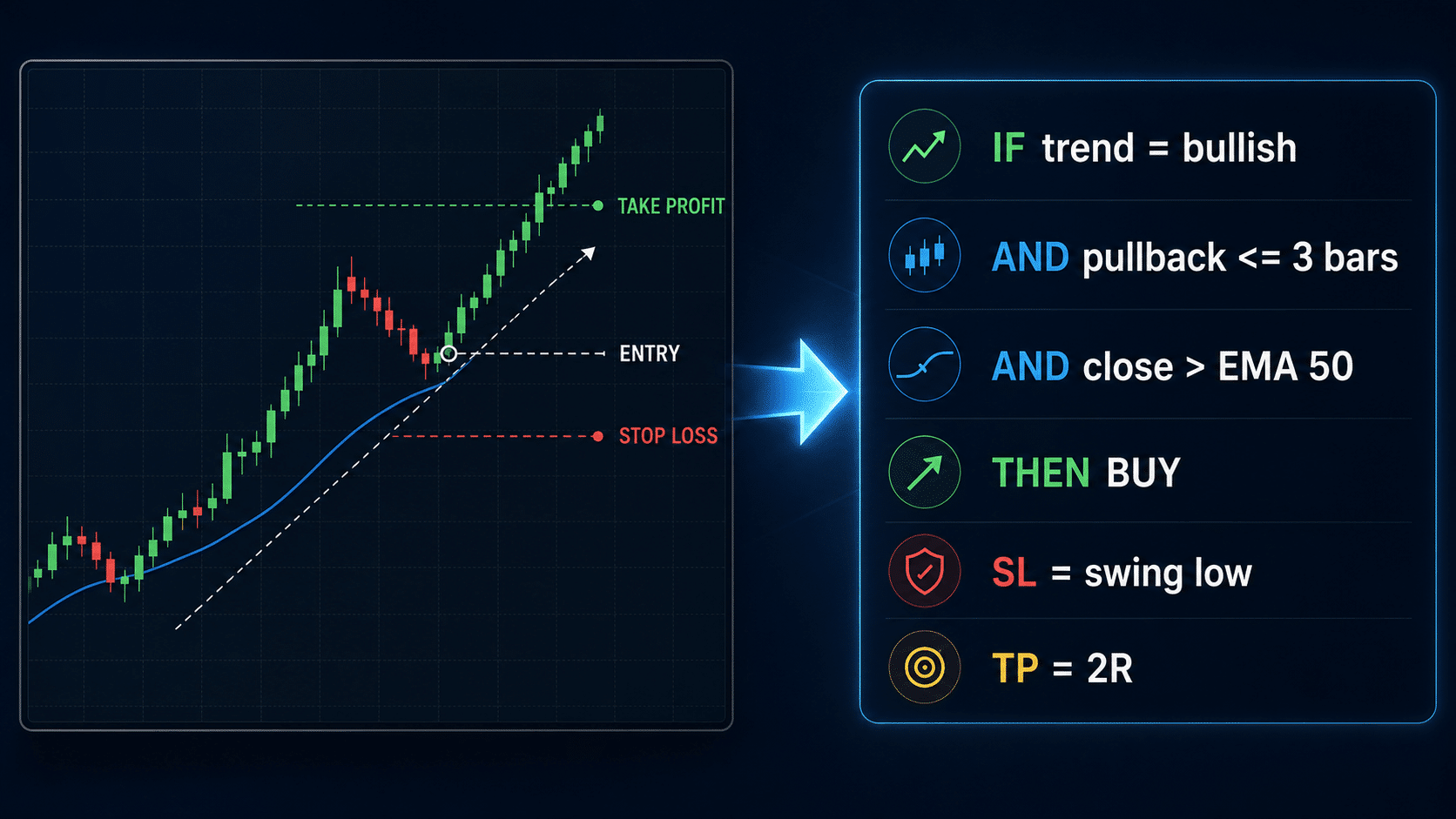
The real gap: "I know it when I see it"
A discretionary trader decides in about a second. You glance at the chart, and something in you weighs the trend, the recent candles, where price sits relative to yesterday, whether the market feels heavy or coiled, and the news you half-remember from this morning. Out comes a verdict: take it, or leave it.
An EA cannot do any of that unless every piece of it becomes a number. It has no instinct, no memory of this morning, and no feel for a heavy market. It has IF and THEN. Every "this looks good" you resolve in a glance has to be rewritten as a condition with a specific value attached, and that translation, not the programming, is where automation lives or dies.
Here is the test that tells you where you stand. Take one rule you trade and try to write it so precisely that a stranger, following your written words alone, would enter the same trades you do. Not "enter on a strong pullback."
How strong? Measured how? A pullback to what, confirmed by what, within how many bars, and skipped under what conditions? The moment you find yourself wanting to add "you'll just see it," you have found the part of your strategy that isn't automated yet.
Where hidden rules hide
Most traders are surprised by how many decisions they make without noticing. These are the ones that trip up almost every strategy-to-EA project.
The filter you apply without thinking. You take the setup in a trending market and quietly skip it when things look choppy. To you, that is obvious. To an EA, "choppy" does not exist until you define it as a number, a range width, an ADX threshold, or a count of overlapping candles. Leave it undefined, and the EA takes every ranging-market trade you would have passed on, and its results collapse.
The context from a higher timeframe. You check the daily before you act on the fifteen-minute, often without registering that you did. If that check is not written into the rules, the EA trades the lower timeframe blind and wonders why half its trades fight the bigger trend.
The exit you feel rather than plan. Manual exits are where discretion runs deepest. You take profit when the move looks tired, you cut early when something feels wrong, you hold longer when it runs. "Looks tired" and "feels wrong" have to become mechanical: a trailing rule, a structure break, a fixed target, a time stop. This is usually the hardest part of the whole strategy to pin down, and the most important to get right.
The trades you never took. Your track record includes your judgment about when not to trade. An EA has no such judgment unless you give it one, so it will happily take setups you would have vetoed on sight, and those are often the losers that drag the system down.
What does the EA building actually look like
A good strategy-to-EA build is less about typing code and more about interrogation. Done properly, it runs through a few stages, and skipping any of them is how you end up with a robot that backtests like a dream and bleeds in live trading.
First, the rules get pinned down. Every entry, every exit, every filter, every "except when" turned into explicit conditions with numbers. This stage is a conversation, and the uncomfortable questions here are the valuable ones, because each vague answer is a future losing trade.
Then the logic gets coded to those rules exactly, not to a cleaned-up guess of what you probably meant.
Then it is tested under realistic conditions, with realistic spreads and slippage, so the backtest reflects a market you could actually trade rather than an idealized one.
Then it runs forward on a demo that mirrors your broker, because the honest proof is how it behaves on data it has never seen, not how well it fits the past.
Only then does a small live account come into play. Backtest, demo, small live, in that order, no shortcuts.
The uncomfortable truth about "profitable by hand"
A strategy that works in your hands does not always survive becoming a machine, and an honest developer will tell you this before taking your money. Sometimes the edge was partly you: your judgment about when to break your own rules, your feel for a bad day, your restraint. Automate the rules, and you may find that the rules alone, without the trader operating them, do not hold the same edge.
That is not a reason to avoid automating. It is a reason to test honestly and find out. Sometimes the EA reveals that your discipline was doing more work than your setup, which is worth knowing.
More often, a strategy with a genuine mechanical edge automates well once the hidden rules are dragged into the open, and then it does something you never could: it executes every valid setup, on every instrument, in every session, without hesitation, fear, or a bad night's sleep.
Build it yourself, or have it built
If you can code MQL4 or MQL5 and you can write your own rules down with real precision, you can build this. The honest bottleneck is not the language. It is whether you can specify your strategy tightly enough that it needs no "you'll just see it" to work.
If you trade well by hand but you cannot code, or you have tried to explain your strategy to a cheap developer and watched them build something that missed the point, that is where a proper custom build pays for itself. The value is not the code typing.
It is sitting with you to extract the rules you apply by instinct, the filters and exits you never wrote down, and turning the whole thing into an EA that trades the way you actually trade.
At Keenbase, we build custom Expert Advisors from manual strategies for a living. We start by pulling your rules apart until nothing is left to intuition, then code and test to exactly what we agreed. You describe how you trade, and we send back a defined scope and a fixed price before any code is written. If what we deliver does not match the brief we agreed on, you do not pay.
Frequently asked questions
Can any manual strategy be turned into an EA?
Most can, if the rules can be defined precisely. The deciding factor is not the strategy's complexity but whether every decision, including the ones you make by instinct, can be written as a specific condition. Strategies that lean heavily on unrepeatable judgment are the hardest to automate faithfully.
Why does my automated strategy trade differently than I do?
Almost always because of hidden rules. Filters you apply without noticing, higher timeframe context you check automatically, and exits you feel rather than plan never made it into the code. The EA follows only what it was given, so the gaps show up as trades you would never have taken.
What do you need from me to automate my strategy?
Your exact entry and exit rules, any filters or conditions for skipping a setup, your risk parameters, and the timeframes and instruments you trade. The clearer these are, the closer the EA trades to your hand. Part of a good build is helping you surface the rules you have not written down.
Will an automated version make the same profit as my manual trading?
Not guaranteed. Sometimes a manual edge depends partly on the trader's judgment, and honest testing reveals whether the rules hold up on their own. A strategy with a genuine mechanical edge usually automates well and then executes far more consistently than a human can.
How long does it take to turn a strategy into an EA?
It depends on how well-defined the strategy is and how complex the logic gets. A clearly specified strategy moves fast. One that needs its hidden rules dug out takes longer, because that discovery work is where the real value sits. You get an estimated timeline with the fixed price before work starts.
Ready to automate the strategy you already trust? Start a Custom Project
You Might Also Like: